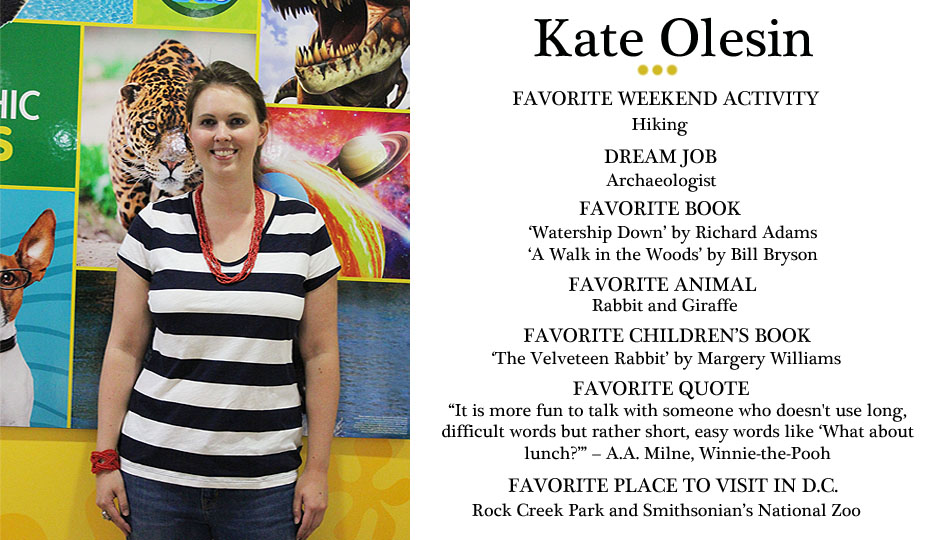
When it comes to creating awesome books for kids, Kate Olesin, Editor at National Geographic Kids Books, knows exactly what she’s doing. Incredibly talented and creative, Kate started her career with National Geographic as an intern in college. When Kate graduated from University of Massachusetts Amherst in 2009, she secured a position as an Editorial Assistant. Over the years, Kate has quickly worked her way up to Editor (and she’s only 27!). Kate’s passion for her work is obvious when she talks about the various types of books she works on, her day-to-day duties, and her love for reading and inspiring kids.
Outside of the NG office, Kate loves to stay active by running, hiking, and gardening. Work life balance is important to Kate, and seeing how she juggles managing a team and 10 projects at a time, having some downtime is very necessary. For all you writers and editors, Kate has invaluable advice to share about how she time manages, seeks mentors, how to set yourself up for success, and what traits make a rockstar intern.
Name: Kate Olesin
Age: 27
Education: B.A. in English and History from University of Massachusetts Amherst
Follow: Twitter / LinkedIn
Carpe Juvenis: How do you define ‘Seizing Your Youth’?
Kate Olesin: Young people are in a really good spot, especially right now, where many companies and professionals are looking for young, cheap, and really smart people. Our youth today are the whole package. They are really taking the time to go after their dream jobs and doing more than they’ve ever done before. Seizing your youth means taking advantage of the skills you already have. You are young, you are smart, and you have a larger breadth of knowledge of this changing world than a lot of other people who are already established in their careers. Young people today are so ambitious and smart and so many of them are just good go-getters.
CJ: You majored in English and History at the University of Massachusetts Amherst. How did you determine what to study?
KO: I was the first one of my siblings to go to college, and it was funny because when I applied to school, I went to my high school guidance counselor’s office because I wasn’t sure what I wanted to do. So, I picked up the biggest book in the office and it was the UMass Amherst book. Then when I got to Amherst, I ended up being placed in an English talent advancement program, and I really loved my classes and all of the people and students I was living with — all English majors. I decided to pursue book publishing pretty early on because of my lifelong love of reading. English really prepared me with the critical thinking skills that I use every day in my job.
CJ: What was your first job out of college?
KO: Getting my first job was a mix of good timing and luck. I actually interned in the children’s books division of National Geographic right after my freshman year of college. I graduated in 2009 in the worst economy ever and I was terrified. Hiring in the book industry was stagnant and I didn’t know what I was going to do. I had applied to publishing companies all over the country as well as some think tanks with zero response. But after completing my NG internship, I knew Washington D.C. was really the city I wanted to be in. So, I looked on National Geographic’s website and knew that they had a hiring freeze going on, but an entry-level position was open in my old division. It was perfect, and everybody I worked with as an intern was still there!
So, I started as an Editorial Assistant at National Geographic after college. I worked on book projects, did the administrative filing and copying, and really threw myself into it. After two years, I became an Assistant Editor. After about 10 months, I was then promoted to Associate Editor, and as of this past February, I am now an Editor. What’s nice about my group is that there is a clear career path and lots of extremely helpful mentorship along the way.
CJ: What sparked your interest in publishing?
KO: I’ve always loved books and I’ve always been a big reader. Ever since I was a kid I tore through children’s books. I grew up within walking distance of my local library, so I was constantly checking out books. But, children’s books are still what I love to read today. I love reading young adult novels. I do like reading adult books, as well.
For a time, I focused on journalism and reporting at my college newspaper and through internships. I did really like being a reporter. It’s demanding and rigorous, but I found that I really wanted to work with books and with children somehow. The nice thing about working at National Geographic, which is such a mission-driven organization, is that the books are non-fiction. We are telling true stories to kids who want to hear them and just maybe they’ll learn something from it. It’s really inspiring.
I wanted to work for a company that would uphold strong educational values, and I think I found one.
CJ: You are currently an Editor at National Geographic Kids. What are your roles as Editor?
KO: A lot of people assume that editors just focus on nitpicky copy editing things. Though I do a little of that, it’s not so much like my time is spent identifying what a past participle is. I do a lot more project management work. My job involves top of the line thinking and wrangling the entire team to make sure all of the pieces come together to form a complete product.
Each editor also acquires titles, and to do that we really look broadly at what the rest of the market is doing. We see what’s doing well, what’s not doing well, and what might fit into our publishing plan. Then we come up with ideas. For instance, I’ve done a couple of books relating to online games, another about George Washington, and another about dog communication. We take popular or core curriculum topics and their characters and tie in real-world information. So, something like taking an exciting game and pairing it with non-fiction information is a way to get kids hooked and inspire a love of reading and the real world.
There’s a lot of development that we do. We have three types of books: gift books, kid-driven books, and library review driven books. Our core age range is 8-12 years old. We also do preschool books and tween books for kids who are 10-years-old and up. So we try and come up with titles that fit into those molds or on topics that they care about.
When it all comes together, I hire authors, we work with our designers and our team of photo editors. Then it just goes from there. I do the text editing and reading through to make sure the narrative and big picture makes sense.

CJ: What is the process for creating a children’s book?
KO: It’s a long process. It usually takes about a year. Printing and shipping the books takes a long time. In the publishing industry your books have to be ready months before they go on sale so all of the major reviewers can review your book. That’s at least six months of time right there.
In our division we’re pretty unique in that we do a lot of in-house development. At National Geographic Kids, we have honed in on what kids want to read and what nonfiction content they are interested in. We take our market research and talk to our panel of about 4,000 kids about what they want to see. We call them our “kid bosses” and they’re very honest with us. When we find a topic that clicks, we get to work.
CJ: What are the greatest lessons you have learned from being an editor?
KO: The importance of relationship building and how to maintain those relationships is one of the big lessons I’ve learned. Having connections and positive relationships with everyone I encounter at my job is really important, whether it’s a big-time author or someone I work with only once.
It’s also been interesting looking at the bigger picture instead of just having tunnel vision and focusing on your own work. Seeing how your book might fit into the broader picture of a marketing plan or a digital plan or anything else is helpful. I’ve learned to see how I can contribute in other ways with great ideas.
CJ: What is the best part about being an editor? The most challenging part?
KO: The best part is physically holding that book you worked so hard on in your hand when it comes off press. All of the photos are high-resolution and the paper is beautiful. Most of our books have a masthead in the back, and seeing your name printed is really nice.
I’m the head of my team for every book I work on. Being in charge of creating a product for children and making sure that it’s wonderful and inspiring is so thrilling. It’s something I never would have imagined that I’d get to do at 27.
The most challenging part is the deadlines. We have a lot of work to do here. Making sure the project keeps moving forward is sometimes a puzzle. It’s sometimes easy to leave projects on the back-burner. I am working on approximately 10 different books right now that are all in different stages. Juggling all of the different pieces can be challenging.
CJ: How do you time manage?
KO: I do a lot of things electronically and I use a lot of to-do lists. We have a couple of project management programs here. And over the past five years, I’ve learned to plan ahead as much as I possibly can and I’ve become a little more firm. It’s easy for a young person to be a little more lenient, but sometimes you have to crack the whip. Not all of the time, and certainly people get busy, but that’s just the nature of working in a time sensitive environment.
CJ: What does a day in your life look like?
KO: When I’m at the office, I read, read, read. Our CEO has a saying that “every day matters” which I think I’ve taken to heart at work and outside of the office. I’ve been trying to focus on a lot of work life balance, which I think is very important. It’s hard to do when you’re a young person just starting out in your career. So, I really try to get my work done for the day, go home, go for a run, make my dinner, and relax. If I have to finish things up at home, I will.
CJ: What should a teenager or young adult who wants to be an editor do to set themselves up for success?
KO: Do as many writing projects as you can. I’ve hired interns and young people to work for me, and the first thing I look for is a well-written cover letter and involvement in writing somehow. It can be for your school newspaper or your own blog or a review site. Good writing skills are a valuable asset. I also like to see young people who are willing to do anything and just throw themselves into any task with a positive attitude.
When I first started working at National Geographic, I did a bunch of filing and copying. Even though that sounds boring, I made it a fun learning experience by reading through every piece of paperwork I had to file and copy so I understood what was happening. If I had questions, I’d ask. I learned our entire filing system and reorganized it for efficiency in two weeks. All of this, which sounds like grunt work, gave me a serious advantage in the end and I was able to understand our administrative process very quickly. Anything that you do can be a learning experience, no matter how menial you feel the task is.

CJ: When you were an Editorial Assistant and as an Assistant Editor, you hired, supervised, and evaluated editorial interns. What traits make a rockstar intern?
KO: An outgoing personality. A lot of times our interns will have to make calls or talk to experts to verify information. They need to not be afraid to pick up the phone to make a call or ask questions to find the answer.
It’s so hard when people don’t know what they’re doing but won’t ask questions. When someone sits there and doesn’t know what to do, the work doesn’t get done. Questions are never dumb. I think a lot of students feel silly when they ask questions, but they really shouldn’t. Questions are a really important part of the learning experience.
CJ: When you aren’t editing children’s books, how do you like to spend your time?
KO: I’ve started running. I’ve been doing that for about six months. It’s important for people to know that when you start working at a demanding job, it is hard to get active. I think it’s important to stay active because it gives me extra energy. I like to hike, garden and generally be outside. I love to go to the Shenandoah Mountains, which are only a couple of hours away. In D.C. there are free museums so there are always awesome things to do.
CJ: What motivates you in your everyday life?
KO: I’ve always enjoyed being a mentor and helping people see the best parts of themselves. I like to inspire ambition in people. Especially working at this organization where our mission is to “inspire people to care about the planet,” that’s something that really drives me. I like knowing that every day when I come into work, I’m helping make a product that can inspire a kid to get outside, or to save lions, or to just love reading.
CJ: How do you go about finding a mentor?
KO: In college I was a peer mentor and resident assistant. Here I try to develop relationships with the people I work with. To be able to go up to them and ask for their opinion about a sentence’s structure, how I might respond to a delicate situation, or for help with a project, is so helpful.
I am a person who loves having people as sounding boards for ideas and questions. Part of it is to feel validated in my own decision-making, but the other part is just to work out the problem. Developing those relationships has been really important. Whether it’s with people here or with authors I work with, it’s a learning experience and I do love to learn. You learn from teaching and you learn from the people you teach.
CJ: What advice would you give your 20-year-old self?
KO: When I was 20, I had about four jobs in school. Part of it was to make money, and part of it was to inspire my love of learning. I worked at my university press, babysat, in an office, and worked on the weekends at a hotel. I would have told myself to take a slight step back once in a while. Take a hike in the woods or go to the beach. Unplug for an afternoon. Everything doesn’t have to be go-go-go all the time. Today when I take a breath, I appreciate where I am and what I have going for me.