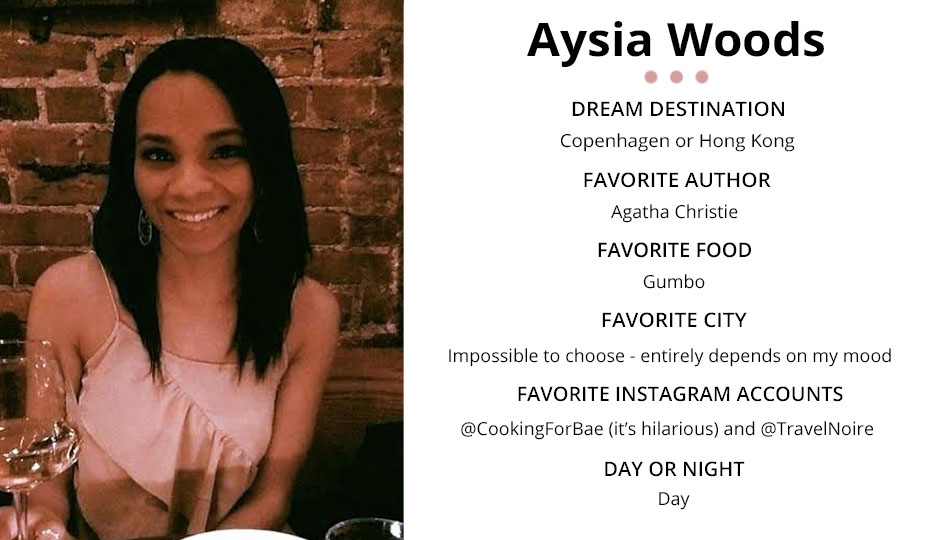
We’re very excited to introduce you to our Travel and Culture Columnist, Aysia Woods. You’ve likely seen her work all over our website (and if not, check them all out here). Currently a graduate student at The George Washington University, Aysia has a passion for all things travel. She has explored many corners of the globe, and we’re lucky enough to get a peek into her adventures through her articles.
We are inspired by Aysia’s honesty, optimism, and determination. Passionate about helping others and living a balanced life, Aysia is someone who 100% seizes her youth. Get to know Aysia, her top travel tips, and how she overcomes struggles below!
Name: Aysia Woods
Education: Graduate student at The George Washington University studying Anthropology and Journalism
Follow: Twitter: @AysiaWoods | Instagram: @FloralGumbo
Location: Washington, D.C.
Carpe Juvenis: How do you define “Seizing Your Youth”?
Aysia Woods: I define it as taking advantage of all youthfulness has to offer – energy, creativity, and adaptability. These characteristics are at their peak in our early years, so I think it is extremely important to nurture them now, rather than later.
CJ: As the travel columnist for Carpe Juvenis, you share your insights and explorations with our community. What inspires you to travel?
AW: I think it’s just in my blood. My parents and the majority of my family grew up all over the world because they were in the military, and they’ve definitely taught me the value of travel at young age. I get restless very easily and exploring is the only thing that quenches that sensation. The fascinating people I meet along the way and those moments where you think, “I can’t believe this is my life,” are what inspire me the most. For example (true story), walking at 1 a.m. along a boardwalk near Cape Town, South Africa, with three European friends, and then happily stumbling upon a club full of Australian tourists hosting their “Latin Fiesta night.” Perfectly random, uniting moments like this are so priceless and inexplicable. I honestly believe if people traveled more often, there would be less conflict because there would be more understanding. The world would be a happier place.
CJ: You recently graduated from college. What has been one of the most surprising changes you’ve dealt with so far being in the “real world”?
AW: I can’t say it was surprising, but I’m still learning just how much self-motivation it takes being the “real world.” Going from being told what to do from teachers the past 18 years with rigid daily schedules to complete independence is definitely a learning curve. Because no one is forcing you to do anything, I think the key to curbing complacency is forcing yourself to stick to a strict agenda and maintain those short-term goals.
CJ: If you could give yourself a piece of advice the day before you started college as a freshman, what would it be?
AW: Start networking long before you graduate. Connections are everything.
CJ: You just started graduate school at the George Washington University – congratulations! What factors influenced you in your decision to both apply to and attend graduate school directly out of college?
AW: Thank you! I am actually in a combined 5-year B.A./M.A. program for Anthropology, so I started my first graduate classes during my senior undergraduate year and now I have just a year left. Because my major had this option, I decided applying to its 5-year program would be a logical choice because it would allow me to save money and time getting a master’s degree elsewhere. Working on a master’s thesis right after graduation isn’t so easy when all you want is the typical post-college Euro trip, but I know it will be so worth it!
CJ: What’s the best piece of advice you’ve received so far?
AW: “Treat everyone like they are special,” which is from my dad. The best advice I get is always from him.
CJ: How do you measure success?
AW: I measure success in positive influence and overcoming challenges. I like to say this rather than something like “100% pure happiness” or “supporting my family” because I think a lot of the time, those are not realistic. It doesn’t matter if someone is a middle school teacher, trash man, CEO, or unemployed. The most successful people, in my eyes, are those who spread joy to others and are resilient.
CJ: You were part of the college club George Washington Women in Business (GWWIB). What was an important lesson you learned through participation in that group?
AW: GWWIB taught me so much about teamwork and the importance of personal branding, which I am forever grateful for. I was mostly involved in their Annual Spring Conferences, which was a great way to learn how to work with a large group, and also an opportunity to learn from and interact with successful professional women. The opportunities that exist in this organization are wonderful and should be taken advantage of. For anyone reading this, I urge you to get involved with GWWIB (men are welcome, too)!
CJ: What is your dream job?
AW: Having a massive family-owned company that publishes a travel magazine and has an accompanying travel agency, opening a few trendy lounges around the world, and eventually opening a retail store. That would be amazing.
CJ: You dedicate a lot of your time to community service. Why is this and would you recommend other young adults get involved in volunteerism as well?
AW: I believe giving back is an integral part of being a good citizen and overall person. If all we do is take from the world, we are leaving behind a void, rather than a legacy. I absolutely recommend other young people get involved in volunteerism. Two organizations I am familiar with are Global Vision International and D.C. Central Kitchen; they both do amazing work in their local communities. There are so many amazing programs – you just have to find one with a cause you are passionate about.
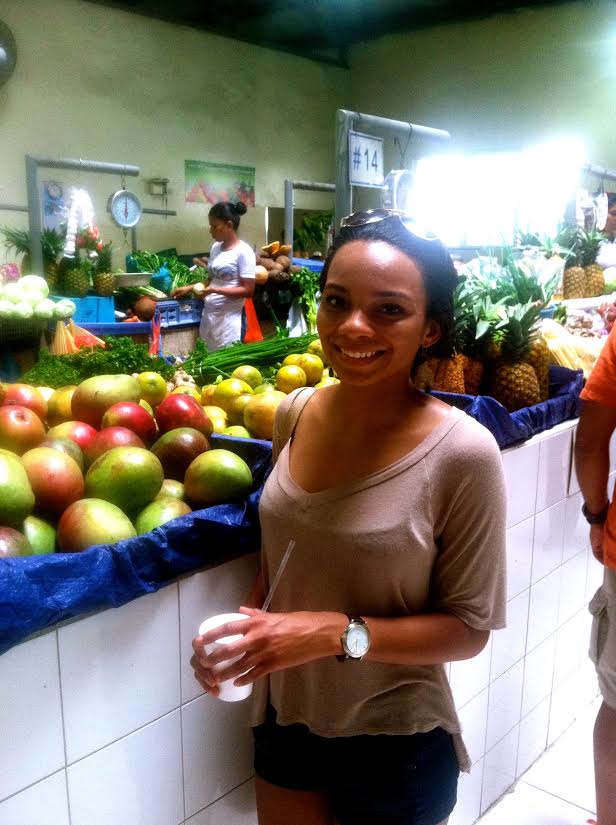
CJ: Where did your interest in food justice and sustainable living come from? What advice would you give to someone new to developing on a healthier lifestyle?
AW: I always knew I was interested in food, but it was my Introduction to Sustainability class I took as a sophomore that truly opened my eyes. In one of the classes, I learned about food deserts for the first time and remember feeling so upset. I couldn’t image growing up with such limited access to fresh produce and not having the power to change it.
From that point, I quickly declared a sustainability minor and loved learning about the relationship between humans and our environment. I feel like the topics covered in this discourse should be taught to everyone! For someone new to developing a healthier lifestyle, I would say try to live a balanced life. To me, healthy living is equal parts nutritious food, physical activity, and mindfulness of your lifestyle.
CJ: How do you deal with difficult days and move past them? What have you learned about overcoming struggles?
AW: This is an embarrassing question for me, but I’ll answer honestly. My first response to a difficult situation is to get a moment to myself and cry it out. At this point in my life, I have learned to just accept shedding some tears as my natural reaction and not fight it. I think that is what overcoming struggles is all about – letting yourself be momentarily upset, de-stressing however works best for you, then finding a solution. Overcoming struggles is a constant in life, so figuring out how you deal with them early on gives you the upper hand for the difficult days in your future.
CJ: What are a few travel tips you always use?
AW: I like to always bring a fuzzy pair of socks in my carry-on for those freezing flights, keep chew-able Pepto Bismol in my pocket at all times (you just never know), and take notes. It’s so sad when you’re back home and trying to remember that song you heard on the radio or that cool shop you are meaning to go back too, but can’t. So, I always type little notes on my phone or whatever scrap of paper I have lying around.
CJ: What is your favorite book?
AW: The Big Sea: An Autobiography by Langston Hughes.
CJ: What advice would you give your 14 year-old-self?
AW: You are on the right path, so don’t try and follow behind anyone else telling you otherwise!
Images by Aysia Woods