steph4
HealthSpotlightYouth Spotlight

We’ll admit that like almost everyone else with a smart phone, we are completely dependent on and obsessed with Instagram. That includes scrolling through the ‘Explore’ option for endless inspiration. One Instagrammer we always find ourselves gravitating toward is Steph Yu of @happyandhealthy96. Not only does Steph share gorgeous photos of the yummy meals she creates, but she encourages all people to find their own happiness and health in their own way.

On top of that, Steph has written an e-book and runs the website A Happy and Healthy Life where she shares recipes, thoughts, health tips, and even more stunning photographs. Oh, and did we mention that she’s only 19?

If you find yourself scrolling rapidly through this week’s Youth Spotlight to see all the beautiful images, don’t forget that there are words of wisdom snuck in between! But if you look first and read after, we won’t hold it against you.

Name: Stephanie Yu
Education: Studying business at the University of British Columbia
Follow: @happyandhealthy96 | A Happy and Healthy Life

Carpe Juvenis: How do you define ‘Seizing Your Youth’?

Steph Yu: To me, seizing my youth is defined by not waiting to live my life, but rather living for the now and not for my future. So often you hear “Oh I’ll do that one day, when I’m older.” But I believe that age isn’t a limitation but rather an opportunity. It’s an arbitrary definition that society tends to use as a barometer for maturity, success, and expectations, but I just like to do my own thing, and live according to my rules and my authentic passions.


CJ: What school do you attend and what did you decide to study?

SY: I go to University of British Columbia, and I’m studying business at the Sauder School of Business.

CJ: What sort of living space do you live in and how do you maintain a vegan lifestyle there?

SY: I live in a single dorm room on campus. It’s actually extremely simple staying vegan and healthy. I have a minifridge and blender in my room that I use daily! I make smoothies, banana ice cream, bring fruit monomeals for lunch, etc. And for dinner I always go to the cafeteria and get a LARGE salad, with rice, or some more fruit!

steph5

CJ: You’ve written an e-book called “Living A Healthy and Happy Life.” What was the process of writing that book like for you?

SY: The process of writing my e-book was both inspiring and difficult. I had to face all my fears, vulnerabilities, and mistakes, and open myself up to possible criticism. But when I started writing it, I promised that I would be genuine and authentically tell my story. I share a lot more than I expected I would, but I’m glad I did, I’ve gotten a lot of emails from people who can relate and that makes everything worthwhile!

CJ: What is the best piece of advice you’ve ever been given?

SY: Follow your bliss.

CJ: To our readers out there wondering how they can take one tiny step towards becoming happier and healthier right now, what one piece of advice would you offer to them?

SY: I would say start with breakfast! That’s really the easiest meal to eat healthy. Have a large fruit smoothie or a fruit meal! Also WATER: drink enough water so that you’re peeing clear. And SLEEP! It’s so important to get enough sleep!

CJ: You’ve experienced your own incredible health transformation. What were some of the difficulties you faced while beginning that process and how did you keep yourself motivated?

SY: It was really difficult for me to deal with social situations when I fist started. I would get a lot of questions that I wasn’t able to answer, and I really felt attacked. I realize now that most people were just curious, so I’d say don’t take things personally and do your research! Become informed about plant-based nutrition, and cover all the basic questions (where do you get your protein, calcium, iron etc).

CJ: As a self-starter you have to keep yourself on track with goals and deadlines. What tools and organizing methods do you use to keep everything running smoothly?

SY: I have a mac, and I use “Stickies” obsessively! I have daily to-do lists, and weekly agendas.

CJ: You have a huge Instagram following! What kinds of things do you do to engage with your community and how has that virtual growth impacted your real life?

SY: I love reaching out to local companies that support the message I do, and introducing them to my followers. I’ve also hosted fruit lucks, and gone to some vegan potlucks! It’s been incredible to find a community here in Vancouver of plant munching people! As for online, I love following and supporting other health foodies, and I’m constantly inspired by others on Instagram!

CJ: What has been the most unexpected part of college so far?

SY: University has been just incredible. The inspiring atmosphere, incredible friends, and total freedom has made this year my favorite year yet.

CJ: You’re also great about making fitness a priority. How do you keep yourself energized throughout the day and especially throughout a workout?

SY: I workout in the mornings before breakfast. I love waking up, drinking a liter of water, and then getting my sweat sesh on! One of my favorite things to listen to during a workout is the Rich Roll podcast.

CJ: What is your go-to recipe for when you just don’t know what you feel like eating?

SY: DATE COCONUT ROLLS!

CJ: What advice would you give to your 14-year-old self?

SY: Your imperfections guide and shape your narrative, love them, embrace them, and accept them.

Images Courtesy of: Steph Yu

Nicole 1
Professional SpotlightSpotlight

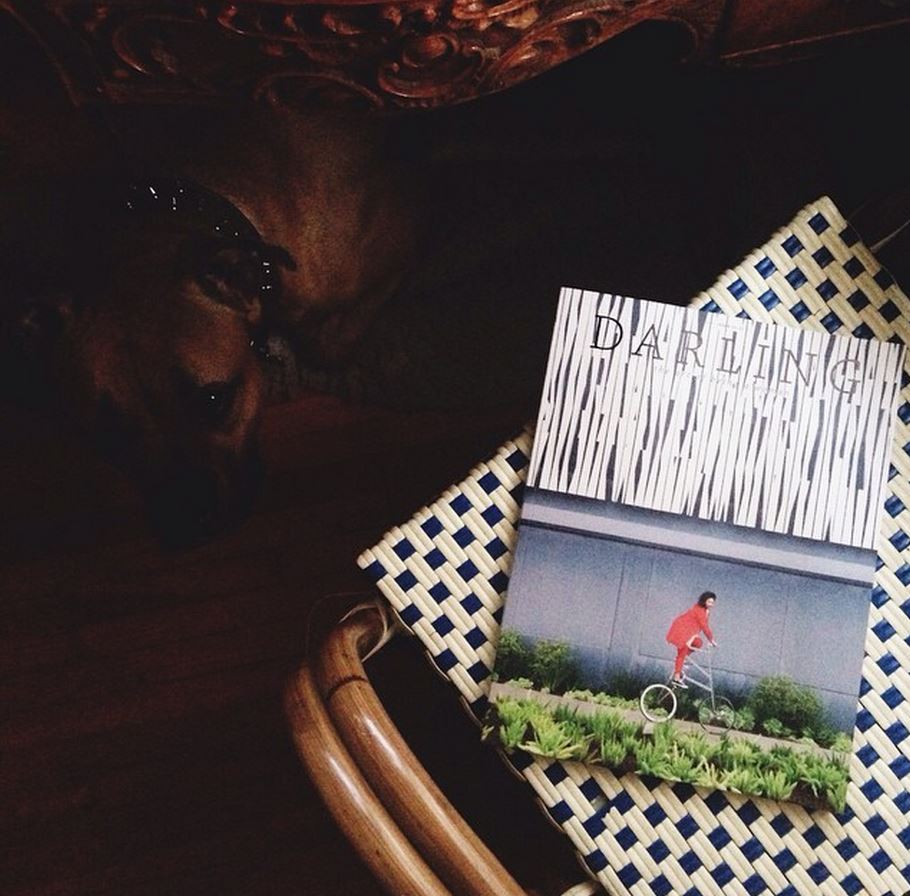
Saying that we are fans of Darling Magazine would be a major understatement. We are huge fans - we love how real it is, the topics covered, and the positivity expressed on each and every page. Did you know that Darling Magazine never uses Photoshop to alter women’s faces or bodies. Pretty cool. Not only is the magazine a joy to read, but the Darling website provides a dose of daily happiness and articles that are deeply relatable.

When you’re on the Darling website, Nicole Ziza Bauer is the one curating everything you see, such as writers, articles, ads, and collaborations. So you can thank her when you read an article that makes you reflect on what’s important in everyday life. Though Nicole now spends her time storytelling, her time used to be spent in labs and conducting medical research. Nicole originally pursued a career in the medical field, she stepped back and thought hard about what she wanted to do, not what she should do. This reflection brought her to a new, more creative path.

Nicole is a world traveler, an avid list-maker, and someone who is true to herself, and her journey will inspire you to follow your heart and to not worry if you don’t have everything already figured out (who really does anyway?).

Name: Nicole Ziza Bauer
Education: B.A. in Zoology and Molecular Biology from Miami University
Follow: NicoleZizaBauer.com / Darling Magazine

Carpe Juvenis: How do you define ‘Seizing Your Youth’?

Nicole Ziza Bauer: Enjoying it, savoring it, not being in a rush to grow out of it.

CJ: You majored in Zoology and Molecular Biology at Miami University. How did you decide what to study?

NZB: I planned on going to medical school after graduation, so I wanted to major in something that would best prepare me for what lay ahead.

CJ: After college you were a Staff Research Associate at UCLA Medical Center researching how the heart works. What was this experience like working in a lab and conducting research?

NZB: Working in the lab was a great transition from college life to the “real” world, since I was still in an academic environment very similar to where I had spent the last four years. It was challenging but also inspiring; I got to be on the very edge of research that could potentially save lives. Though there was a lot of monotony and repetition in the lab, each day also held the potential of unlocking something that nobody had ever seen or understood before. That was really motivating.

CJ: After preparing for medical school and doing post-grad research, you switched career paths and went into a career of storytelling, writing, and creating. Before Darling Magazine, you were a Purchasing Agent and Event Coordinator. What inspired this change of heart and how did you deal with the stress of making this transition?

NZB: I wish I could say it was one simple thing that sparked the change, but nothing in life is ever that black or white. While I was excited about medical school and worked really hard to get accepted into one, I also kept a strong inner dialogue after college and that prompted me to truly evaluate where I saw my life headed and if there were other things I might want to do instead of becoming a physician.

I had always been a creative child and writing and art brought me a lot of joy. When I stepped back from what I thought I “should” do in order to appear successful in the eyes of others and slowly started asking myself what I wanted to do, the answer came into focus. From there I started looking for opportunities that would better enable me to learn and grow creatively.

Nicole and Horse

CJ: How were you able to block out the external voices and follow your internal compass?

NZB: Trusting that I didn’t have to have it all figured out, or have a clear idea of my career path once I graduated helped to free me from the stress surrounding the decision. I had to (and still do) remind myself that taking things one step at a time is OK. Our character and appreciation of life is built in those tiny steps. Thankfully, I had a few close friends that I could lean on when I was deciding whether or not to go medical school who guided me out of the fog a bit. Having those trusted sources to remind you of your worth, your convictions and your big dreams is so, so important.

CJ: What advice would you give a young adult who might be at a “passion crossroads” in his or her life?

NZB: I would say: Hi, can I give you a hug? Because you are completely normal!

College is great for so many things, but a lot of times it can also lead us into a false belief that it’s the only time in life to figure things out or decide our future. That’s simply not true. If you are conflicted over what you’re pursuing right now, ask yourself some tough questions: Why did you choose the road you’re on in the first place? Whose applause are you seeking? Do you want out because you’re afraid of hard (sometimes tedious) work? Or are you simply realizing that there might be other avenues out there that you’d enjoy and want to explore?

Our early to mid-20s grant us many opportunities for making decisions and learning how to make independent choices. It’s really important that we look at crossroads or changes of heart not as failures, but as chances to better understand how we’ve been made, who we are, and what our unique role in the world should be.

CJ: You are now the Online Managing Editor at Darling Magazine, a guide to “the art of being a woman.” What does your role as Online Managing Editor entail? What do your daily tasks look like?

NZB: As online editor I’m responsible for all the website, blog, and advertising content that Darling develops. This involves creating and maintaining an editorial calendar (so that our site always has new material), finding and communicating with writers, and generating article ideas, and sometimes even writing myself. My daily tasks include lots of emails, reading and editing articles, chatting with different Darling staffers, and maybe a meeting or a phone call with a brand about potential collaborations.

Nicole ZB

CJ: You curate content, writers, ads, and collaborations on the Darling website. How do you go about narrowing down content so it fits the Darling mission, and how do you establish collaborations?

NZB: Great question! Knowing what you stand for is key to developing a powerful brand. Therefore, with Darling I’m constantly evaluating if something will serve to reinforce our mission statement or if it’ll conflict with it. I try to put myself in the position of a reader and ask: What would they take away from this article? Would they be more inspired to own the things our mission statement says about them, or less? The same goes for working with other writers and brands. We have to be on the same page, working together for that same common goal, rather than just using one another for increased status or popularity.

CJ: We loved your inspiring article ‘The Myths of Wanderlust’ – how has traveling influenced you, and is there a particular trip you have taken that stands out in your mind?

NZB: Thank you! Traveling is definitely something that I choose to prioritize, as it helps to keep my problems small and sense of wonder and world awareness large.

Probably my favorite adventure to date was the month I spent backpacking around Italy with my husband. My grandmother was Sicilian, so I’ve loved everything Italy since childhood. I studied the language a bit in college and then spent a few weeks in Rome after graduating, but getting to go off the grid around the entire country (for a whole month) felt like a dream. It was like coming home.

Darling Mag

CJ: How do you stay organized and manage your time?

NZB: I am an avid list-maker. Every thought, idea, or task that I need to accomplish gets written down, that way I immediately get it out of my head and onto a tangible piece of paper. From there, I look at my week’s agenda and decide when I can schedule time to complete the most pressing tasks. I never go anywhere without my giant, spiral-bound notebook calendar.

CJ: When you are feeling overwhelmed or having a bad day, how do you like to unwind or reset?

NZB: It depends. Sometimes I just need to say a quick prayer, vent to my husband or call my best friend. Other times getting outside and taking my dogs on a walk or going for a hike will help. And when all else fails … I’ll watch old Netflix episodes of Murder, She Wrote. JB Fletcher can solve anything.

CJ: Is there a cause or issue that you care greatly about? If so, why?

NZB: I love animals, so I’m a huge advocate of pet adoption. Not only can we provide an animal with a safe and loving home, but we in turn learn compassion when we care for things smaller and less consequential than us. Darling also has a partnership with IJM, of which I am a huge fan. They have such a comprehensive model for bringing justice and eradicating sex trafficking across the globe. It’s very impressive and inspiring.

CJ: What are you working to improve upon – either personally or professionally – and how are you doing so?

NZB: Lately I’ve been trying to get by with less, get rid of more, and curb the mindless spending that’s all too easy to fall into, especially after trolling blogs or social media. In the last few months I’ve donated about five bags of clothing, which has been really eye-opening to consider, especially when I find myself “needing” something new. Most likely, I don’t.

CJ: What is your favorite book?

NZB: The Count of Monte Cristo by Alexandre Dumas.

CJ: What advice would you give your 20-year-old self?

NZB: Study abroad. Also, take a deep breath; this is just the beginning.

Nicole ZB Qs


Images by Emily Blake and Nicole Ziza Bauer

Tully Phillips
Professional SpotlightSpotlight

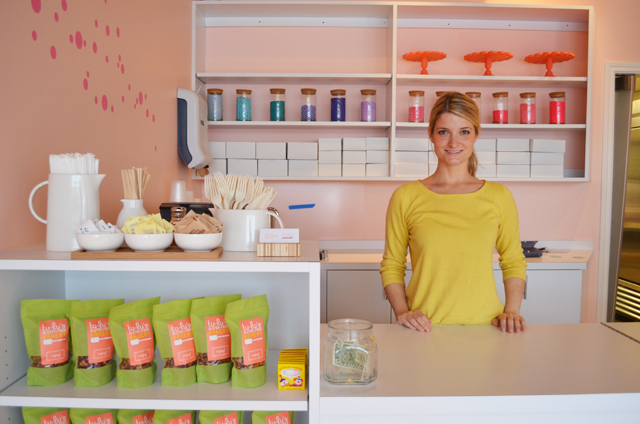
We became (just slightly) obsessed with Tu-Lu’s Gluten-Free Bakery when we stumbled onto the vegan granola at a local health store. Once we enjoyed the sweet, filling, and delicious granola, we had to know who was behind the magic. Baker and founder Tully Phillips shares her story and advice with Carpe Juvenis. From New York City to Texas, this entrepreneur knows what it’s like to open up bakeries across the country and discover a passion that was hidden right under her own nose for years.

For anyone excited about starting their own baking venture, or who just loves to get their hands dirty in the kitchen, we are extremely excited to share this week’s inspiring Spotlight with you!

Name: Tully Phillips
Education: Southern Methodist University and Le Cordon Bleu in Austin, TX
Follow: @tulusbakery / Tu-Lu’s Gluten-Free Bakery

Carpe Juvenis: How do you define ‘Seizing Your Youth’?

Tully Phillips: I think it’s best to seize every opportunity to learn and gain experience when you are young. Try all sorts of things because you never know what might pique your interest!

CJ: What did you study at Southern Methodist University and how did you determine what to major in?

TP: I was a fine art major. It was an easy decision for me because I loved painting and creating art in high school. I have a real need to be creative and that translated into cooking post-college.

Sara Kerens 2012

CJ: You attended culinary school at Le Cordon Bleu in Austin, TX. What inspired you to pursue cooking in an academic way and what was that experience like?

TP: I have always loved cooking. I find it extremely relaxing, an outlet for creativity and of course a delicious profession. Going to school for something that was formerly a hobby was a dream come true. Some people might think culinary school is relaxed but it is actually quite strenuous. You have to be on point every day because each dish you create is graded. Despite that, I still enjoyed every moment.

Sara Kerens 2012

CJ: You signed your first lease for Tu-Lu’s NYC bakery at the young age of 28. How did you decide where to start and which area of the city to rent in?

TP: I wanted to be in a neighborhood that was a “foodie destination.” The East Village is one of those areas of Manhattan with such a variety of restaurants and is quite the hang out area on the weekends. The less expensive rent was also a deciding factor. It was important to me not to overspend on rent since it was a new business and quite frankly a new concept for NYC. We were the first 100% gluten-free bakery in Manhattan so I was not sure how successful we would be.

Tp 1

CP: In your roles as founder and owner, good leadership is critical. How have you learned to lead and what does it mean, in your opinion, to be a strong leader?

TP: I think a leader needs to be experienced in all the roles of their employees. When we first opened I was the dishwasher, weekend baker, register employee, as well as having all the managerial duties. I learned the ins and outs of each position, which was helpful in delegating work and projects to my employees. I think you also have to be willing to learn from your employees and listen to them. Be open to tweaking how things run according to advice they give you.

CJ: How did your education and past work experiences prepare you to start Tu-Lu’s Bakery in both New York and Texas?

TP: I helped manage the kitchen in a catering company NYC. That job really taught me how to be confident in having employees and letting them know your expectations and limits. Of course my culinary education and work experience directly influenced the quality of our baked goods. I have very high standards for what we sell at Tu-Lu’s.

Sara Kerens 2012

CJ: What have been the greatest challenges in running your company, and what do you wish you had known before opening your bakeries?

TP: We are open seven days a week in NYC with very long, late hours so essentially we are never closed! There is always something that comes up that needs to be addressed. Whether it’s someone not showing up for work or a light fixture that no longer works, owning a business is a 24 hour, seven day a week job. That might have been nice to know before opening!

CJ: What is the greatest lesson you have learned from being an entrepreneur?

TP: Being an entrepreneur is risky but extremely rewarding. I was so scared to open a retail store in the middle of New York City but once I signed that lease I didn’t look back.

Tp 2

CJ: What should a teenager or young adult who wants to have their own bakery and run their own business do now to set themselves up for success?

TP: I recommend working at a bakery to really learn the ins and outs of the business. Try to work your way up to assistant manager or manager to get experience on all levels. Knowing how to manage people and money is key. Though I had culinary experience, I had never worked in an actual bakery so I could have learned so many things and avoided quite a few mistakes and bumps in the beginning.

Sara Kerens 2012

CJ: You’ve had such incredible feedback about your gluten-free products, especially the delectable brownies and Carpe Juvenis’ personal favorite, the Agave Cinnamon Granola. Aside from your own experience being gluten intolerant, what inspires you to create delicious treats that anyone can enjoy?

TP: I created the bakery to fill that void of not having delicious GF treats available to me. I was shocked I could not find a wonderful GF cupcake in all of Manhattan. We are always trying to create new products to excite our customers. I especially love when we can recreate a childhood memory in a GF version.

Sara Kerens 2012

CJ: What motivates you on your toughest days?

TP: We have the best customers and we are always striving to make them happy. I can’t tell you how many times people have thanked me for opening the bakery. How many people get thanked on a regular basis at their job? Not many! That completely makes up for the tough days.

CJ: What advice would you give your 19-year-old self?

TP: I would probably tell myself to get a job at a local bakery and learn as much as I can about their systems, customer service, accounting, etc. Try to get some marketing and PR experience as well. You can never learn too much and all knowledge is useful! You never know where it will take you.

Tully Phillips Qs

Images by Tully Phillips

Meagan A
Professional SpotlightSpotlight

When we think of people who have inspired us, Meagan Morrison comes to mind for several reasons: she created her own dream job, she’s incredibly talented, and she’s contagiously optimistic. You can tell right away from seeing her illustrations how much skill Meagan has, and you immediately get drawn into her colorfully brushstroked world.

Though Meagan studied business in undergrad, it wasn’t until she was 24 that she decided to go back to school for a degree in fashion illustration. After doing internships and asking lots of questions, Meagan realized that she was going to have to create the dream job she ultimately wanted. The awesome and inspiring part? She did just that.

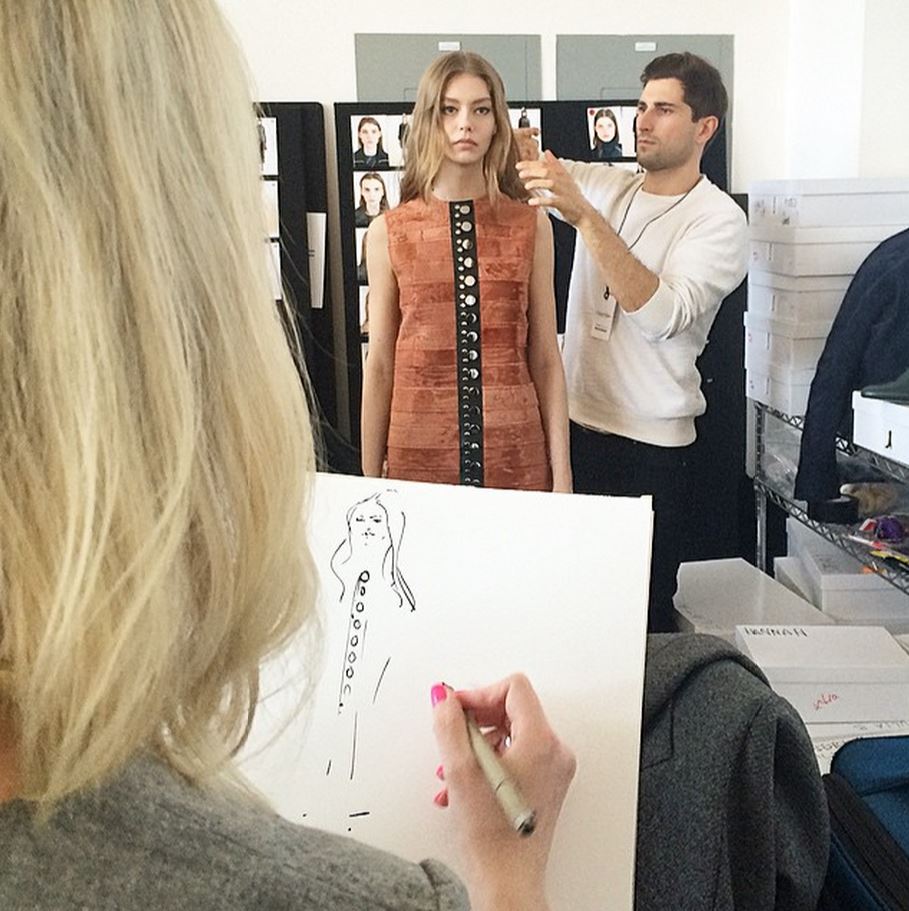
As a Traveling Fashion Illustrator, Meagan works with fashion designers and high profile brands and travels the world illustrating what inspires her. During our conversation, Meagan consistently referenced how much hard work it takes to make your dreams come true and that you have to “rewire your brain to think positively.” Very true words, and it’s encouraging to know that the road to your dreams may not be easy, but it’s definitely worth the challenge.

We’re excited to share with you Meagan’s interview with Carpe Juvenis! Read on to learn about her role as an illustrator, the greatest lessons she’s learned from starting her own company, and of course, how she seizes her youth.

Name: Meagan Morrison
Education: Bachelor of Commerce from McGill University; Fashion Illustration AAS from Fashion Institute of Technology
Follow: MeaganMorrison.com / Instagram / Twitter / Facebook

Carpe Juvenis: How do you define ‘Seizing Your Youth’?

Meagan Morrison: Making the most of every opportunity and asking tons of questions. Those who seek will find. Don’t wait for anything to fall into your lap, you have to go after it. Since I was very young I’d always ask a lot of questions to family friends and teachers. I was constantly educating myself and involving myself in things that I found interesting. ‘Seizing Your Youth’ is ultimately defined by each individual and what he or she wants to get out of life.

CJ: You received your Bachelor of Commerce from McGill University. What did you major in and how did you determine what to study?

MM: I went to McGill and studied business. My older sister went to McGill, as well. When I went to visit her, I remember looking at the girls in the commerce program and I loved seeing how they carried themselves. They were well dressed and professional. I really identified with them. They looked confident, empowered, and determined.

At the time I was very much into fine arts, but I wanted to step out of that for a bit to find myself and my purpose. I knew that with a foundation in business I could specialize and go smaller, but it would be harder to go from something narrower to a business degree. It felt like the right building block at the time.

Meagan D

CJ: You also received an Associate’s Degree in Fashion Illustration AAS from the Fashion Institute of Technology. What was that experience like?

MM: By the time I started my AAS in illustration I was 24 and really knew that the program was what I wanted to do. It was a highly specialized degree that offered fashion illustration as a two-year program. I didn’t want to commit to another undergrad degree, but I wanted a foot in the door in New York. I also wanted to be totally immersed in fashion illustration. I read this quote in a book about fashion illustration that advised to launch your career in a city that matters. I figured if I was educated here and given the opportunity to work here, I would be launching myself in the biggest city in the world for my industry. That’s what prompted my decision to go back to school.

Meagan Insta 3

CJ: What sparked your love of illustration and design?

MM: I always loved fashion and art. I didn’t quite know that they could co-exist so intimately until I started working in the fashion industry after McGill. My first internship was at a fashion magazine and I was constantly asking questions between the editorial department and the art department to see how much, if any, traditional art they used. It was predominantly graphic design and photography, so I didn’t see myself in that world. I thought maybe I belonged in the gallery world of fine art. Somewhere between trying out a bunch of different professions in the industry and asking questions, one of my coworkers mentioned the program in fashion illustration at FIT. When I heard the profession and researched it, it felt as though a lightbulb went off. I couldn’t believe that I found something that really combined my true greatest loves: art and fashion. That’s what really sparked the passion for me.

After hearing about the profession and the program at FIT, I went to bookstores and pulled all the sources I could find on fashion illustration. I searched through the glossaries and found names of illustrators, and some were located in Toronto. I reached out to Virginia Johnson, a local Toronto illustrator and textile designer, and brought her my portfolio. I explained to her that I loved illustrating shoes, and she pushed me to follow what I loved and told me that the rest would fall into place. I’ve been obsessed with illustration ever since.

Meagan Insta 2

CJ: You are a traveling fashion illustrator and recently branched out to start your own company. What does it mean to be a traveling fashion illustrator?

MM: It’s about being mobile and not just sitting at my desk pulling images off of the Internet. It’s about experiencing the culture firsthand and having that inspire my work. I have always been so passionate about travel and how that would inform my illustrations, and I wanted to be known as an illustrator at the intersection of both travel and fashion. There’s nothing like discovering a new destination and seeing how people dress in different cities around the world. I want to capture how the environment they’re surrounded by influences their style and my work. It’s the same thing when I’m at a fashion show and later do illustrations. I’ve seen the clothes, felt the texture of the fabric, heard the playlist, and felt the mood of the environment. I see the vision that the designer intends for the line. It helps bring the illustrations to life.

CJ: What are the greatest lessons you have learned from starting your own company?

MM: That you never stop fighting. Every paycheck is a fight. Every project is a new hurdle. I don’t mean to sound defeated by that, but it is the most obvious and striking contrast between working full-time and working for myself. I knew every two weeks I would get a paycheck at my last job, but now I have to chase and follow-up on everything. All the work of orchestrating that and keeping projects moving can be a challenge.

I’ve also learned that it would be great to have a sounding board. The thing I miss about working with a company is having the team to bounce ideas off of. It’s always a joint decision. I love the fact that I am making choices for myself and I do have the final say, but I think it’s good to discuss the decision with someone first and come to a well-informed decision. It’s a lot of pressure to not make the wrong choice on your own.

You also have to be careful so you don’t get taken advantage of. You’re constantly looking after yourself. The momentum has to keep going and the ball can’t drop. I find that the more I’m working, the more work comes in. It’s the ripple effect. The chain reaction in itself can be exhausting because when can you ever pause and catch up on your sleep?

CJ: You have done illustrations for amazing clients including Lucky Magazine, Rebecca Minkoff, Calvin Klein, and Conde Nast Traveler. When you work with each client, what is your process and your role as an illustrator?

MM: It honestly differs with every client, how big the project is and how much they want to involve the social and illustration aspects of it. When I come into a partnership I always gauge what the client’s expectations are, the breadth of the project, the timeline, their budget, and then we work from there. It’s about finding the middle ground between what you feel comfortable with and what the client feels comfortable with.

I have a clear vision about the brands I want to work with and how they align with the vision I have about being a traveling fashion illustrator. I don’t take on every project. If people want to sponsor things on my Instagram, I don’t take every product. Every partnership is very authentic. I don’t ever take on a job just for the money; I only do it when I believe it’s genuine and it makes sense.

Meagan C

CJ: How long does a piece take to create from start to finish?

MM: It varies per project and per client. For instance, my Calvin Klein job, I was at the show illustrating live. I could feel the fabrics and speak to the creative director, Francisco Costa, about his vision. I had about two days to turn around finals, but it helped to see the actual clothes. The pieces themselves takes me about three to four hours to complete, but that varies depending on how detailed each piece is. Then I scan the paintings, clean them up in Photoshop, and send the JPEGs to the client.

If it’s a customized piece or if I’m designing something from scratch, that requires a lot more preparation. I’ll do pencil sketches and color comps and then take it to the final round. Some are more laborious and expensive and others are just straight to final.

Meagan Insta

CJ: What should a teenager or young adult who wants to be a fashion illustrator do to set themselves up for success?

MM: Start asking questions and get a portfolio together. Also, don’t lose your voice. When people are younger they start to emulate the top people, but that’s not an advantage. People don’t want to hire a second rate version of someone else, they want to hire the first version of you. I’ve seen it on social media where people’s styles are so different, and that’s what’s standing out. It’s a saturated market. Keep true to you and keep your voice and style genuine. Embrace the quirks about your style.

There are tons of free websites out there as well where you can put your work online. Keep it clean and simple so you can showcase your work. When I was younger I was constantly illustrating to keep perfecting my craft and finding my voice. I wasn’t thinking about gaining clients just yet. Build your social awareness and share your journey. Then, when you are ready to work with clients, people will already know about you.

Meagan Insta 4

CJ: How do you stay organized and manage your time?

MM: I have a massive planner that is 8½ x 11 inches. I write lists every single day, and everything that doesn’t get accomplished the day before gets carried over to the next day. It’s blinding because I highlight everything. I also use whiteout so there’s nothing unnecessary on it. I start and end my day with that book.

From the planner I move to emails. The luxury of working for myself is that I can answer them when I’m in still in my pajamas. I get breakfast and then do errands. I want to get all my errands finished before I start painting, because once I start painting I lose track of time. It’s nice to have everything else taken care of so I feel at ease when painting. I don’t want stress to show through in the work. I often work pretty late into the evenings. It depends on how intense the turnaround time is. I like to end the day seeing a friend or unwinding watching Netflix.

One thing I’d like to do more of is exercise. You have to take care of yourself when running your own business. If you run yourself down there is no business. I don’t have weekends. I haven’t taken a proper vacation when I’m not working. For better or worse, travel has become part of my brand so I feel a sense of responsibility to cover what I’m doing and share it on social media even on my downtime.

Meagan Insta 5

CJ: What spring break experience has been memorable for you?

MM: I remember the spring break in my senior year of high school. I traveled with my class to France and Italy. That trip stands out to me because we had a small group of students in my high school, and we were combined with another high school group from the Ontario area. We got to meet new high school students on the trip and it was a prelude to university and meeting new like-minded people. I love how traveling and meeting new people expands your vision.

We started in Paris and hopped over to Florence and Rome. I had the time of my life. It wasn’t about the accommodations or amenities at all. It was about being with people you cared about, having a blast, and laughing a lot.

CJ: Is there a cause or issue that you care greatly about?

MM: Changing the perceptions on mental health, depression, and anxiety is important to me. I don’t think people should be scared to talk about it. Being open and dealing with it as you would your physical health is important. There’s more people suffering from anxiety and depression in the country today than there has ever been. Why is that? It’s a blessing and a curse that we have social media, but it also gives people a sense of inadequacy all the time. You’re constantly faced with what other people are doing and how much more you should be doing.

I’ve had to really practice changing my mindset about that. By nature I’m very anxious and hard on myself. I practice gratitude. My anxiety can be so bad that it could hinder my work flow. When things aren’t totally concrete I’m at my worst. The grey area is the hardest area to live in, but that’s life. Rarely is anything concrete.

CJ: What is your favorite book?

MM: Eat, Pray, Love: One Woman’s Search for Everything Across Italy, India and Indonesia by Elizabeth Gilbert.

CJ: What advice would you give your 20-year-old self?

MM: I’d say not to worry and that everything is going to work out just fine. I feel more confident now than I ever have. Looking back at all the things I didn’t think I could get through, that I have since surpassed, helps me to remember that everything will always work out. I didn’t know then that I’d be able to build a life that I love so much.

I would advise people in their twenties that nothing is handed to you. You have to practice happiness. It can be tough but you have to practice that in the same way you train for a marathon. Rewire your brain to think positively. Also know that happiness isn’t at the other end of success. You can start with happiness and then everything else doesn’t have so much weight on it. If your happiness is contingent upon getting into a certain college or winning a certain award or landing a client, then you’re never going to get there because the benchmark is always raised.

But if you start with being grateful with what you have in the moment, then you’re already working at an advantage. Be grateful for what you have because it can all be gone tomorrow. I feel infinitely happier now than I did way back then, even though I have tons more responsibilities. It’s been a matter of self-awareness and rewiring the way that my mind works.

Meagan M Qs

Images: Illustration Images by Meagan Morrison; photos of Meagan by Carpe Juvenis

Alex A
Professional SpotlightSpotlight

When we first saw Alexander Chinnici’s film reel, we were blown away. You hear a lot about actors, actresses, and directors, but rarely do you know a lot about those who are in charge of the artistic and technical aspect of the image, the cinematographer. Having watched movies such as Aliens, Predator, and Apocalypse Now growing up, Alex learned early on good films can influence you. Alex pursued film in college and by the time he graduated, he knew that cinematography was what he was most passionate about.

Alex is thoughtful in his artistic and technical approaches. He emphasizes the importance of building a solid foundation of knowledge and technical expertise, as well as highlights the value of collaboration, whether it’s with directors, producers, or the team he manages. These days, Alex spends a great deal of time on airplanes traveling between coasts for shoots. We were fortunate to meet Alex before he jet off for another shoot the next day, and he shared with us what it means to be a cinematographer, what films and which directors deeply influence him, and how he seizes his youth.

Name: Alexander Chinnici
Education: Film and Video; Cinematography from the School of Visual Arts
Follow: AlexChinnici.com

Carpe Juvenis: How do you define ‘Seizing Your Youth’?

Alexander Chinnici: Seizing Your Youth, to me, means “breaking convention.” First off, youth is subjective in and of itself. To me, a child, a teenager, or even someone in their early 20s is expected to do certain things. Depending on where they’re from, their race, gender, etc. …It’s expected that they do certain, specific things that are molded for them before they’re even born. Seizing that is about control. You can do whatever you want; you just have to want it badly enough.

For some people the stakes are much higher and the obstacles may be much greater, but anything is possible. I don’t mean to make it sound easy - sometimes it is, some people are born privileged. For others it can be very difficult. I’m very fortunate that I didn’t really experience that difficulty. Seizing Your Youth is about taking control of what’s yours and not giving in to conventions. They’re usually connected to fear and it ultimately hurts our culture. I’m very lucky to have grown up in a home and an environment that encouraged the opposite of convention. I have very little patience for excuses. Seizing Your Youth is about throwing those excuses away and taking control of what you want.

CJ: You majored in Film and Video with a concentration in Cinematography from the School of Visual Arts. How did you decide what to major in?

AC: The School of Visual Arts Film & Video program is set-up in such a way that your first year is an overall review of the general aspects of the film industry. They teach you the basics, but most importantly you can get your hands on cameras and just shoot away. At the end of the first year you have to choose a focus: Directing, Writing, Editing, Cinematography, etc.

My friends and I made many movies together in high school - basically since 6th grade - and I naturally gravitated to the camera. (I should also mention that my Dad is a photographer). Toward the end of high school we got more and more serious. After three of us went to SVA together, I naturally took over when it came to the camera. 16mm was introduced into our lives and we were terrified (“Wait, you can’t see what you’re doing!?”)

I can’t really say why, but when students in the class (and my collaborators and best friends from high school) asked “Can someone shoot my film?” I jumped at the chance. I had never shot film before and admittedly I was very scared of it. At the time I was struggling with the idea of becoming a director simply because in the world of film you’re told that’s exactly what you should be, especially in film school. Not having full control worried me but in the end I continued to gravitate toward the camera. This was also my first experience with lighting. I simply had no clue about it beforehand and now a brand new language was being introduced to me.

Combine the romance of film (like a first love), discovering the language that is constant lighting, my natural instinct, and the older thesis students telling me that graduating without a focused skill would mean certain death led me to the choice of majoring in Cinematography. Needless to say it was the right choice. It is a skill that takes a lifetime to learn and I plan on doing just that.

You are also a cinematographer for narrative and commercial work. What does it mean to be a cinematographer? What do your daily tasks look like?

AC: The Cinematographer is in charge of the overall visual language for the project. It is always this person’s task to put story first and foremost with the directors vision in mind at all times, to serve them, and to collaborate with them (the amount is usually dictated by the director). Consistency is also very important; making sure that the style stays consistent throughout and only changes when necessary. A cinematographer is one part technical, one part artistic. It is a wonderful meeting of the two. The goal is to achieve an image that the audience doesn’t think about. The technical becomes hidden in the background and the emotion of the image takes shape, hopefully affecting the audience in the exact way that the two of you conceived. In my personal opinion, this is when it is most effective.

The Cinematographer works with other department heads to strive for that consistency. Collaborating with them is extremely important and I try my best to make this happen each and every time. They’ve also spoken with the director and usually we’re all on the same page. We work hard to make the director’s vision come true, but we’re hired as the experts in each of our respected fields. We’re also usually hired because of a particular ability, style, technical know-how or even personality. We spend a lot of time together on set; you have to respect and trust the people you’re around. It is filled with constant decision-making and compromise. Those tasks are not easy if you don’t get along.

My daily tasks depend on what’s going on with the project. While in pre-production, my life is about preparing for production. Seeing locations with the director, locking in my crew, shaping the schedule with the AD and working within the budget constraints. I do my best to squeeze the most out of the amount that’s been allotted to me. The director and I work closely to discover the style of the film. We may watch films; review photos or works of art, discovering the right references helps us get on the same page. We also work hard to choose the correct camera and lenses. This is based on a desired look, the budget and specific logistics often shaped by the script. Often we compare past experiences and watch projects shot with similar combinations. The camera and lenses is arguably the most important choice before we get to set.

On set my daily tasks are always very different each and every day. That is one of the most exciting aspects of the job. To be broad I’d say that it usually begins with a strong plan that we had settled on the day (or days) before. I meet with the Assistant Director (AD) and the director to discuss said plan and we see if we can improve it. Or if a disaster has struck, how do we deal with it? If I’m lucky the AD will get a blocking rehearsal going and we can watch the scene. This will inform everyone of what’s happening. Not every set is so organized, but when it is you can do your job much better. I’ll quickly review this with the heads of my team and they’ll delegate and convey what needs to happen to their crew. After that it often comes down to maintaining a groove, time is extremely important on set.

We usually have 12 hours per day to get everything we need. We face many obstacles like the movement of the sun, actors and/or actresses becoming restless, locations only allowing a certain amount of time, etc. The clock is always running and you have to race against it. It’s often my job to keep us on track and constantly make sure that the shooting order is correct. I need to be thinking five shots ahead at all times. While this is happening I’m placing the camera in the correct place for said moment, with the correct focal length and such. These decisions are often shaped by the location and the blocking of the actors. I work simultaneously with the Gaffer on the lighting of the scene.

Moving a camera around is one thing but lighting a set or a real location can become very complicated. The two are strongly connected and affect one another greatly. The order of how all of this works must be taken into account. The director and I often discuss the editing as well. How is this scene going to take shape? This certainly informs the decisions we make. “Making our day” as we call it is extremely important. If we love the footage and we’ve made it, it’s considered a success. My day is about making those two things happen.

Alex E

CJ: When you’re on set, what aspects of the story and the characters’ movements do you have to consider? At what point do you come in – has the scene blocking been done, do you work with them while doing that?

AC: I think it’s very important that everyone witnesses the blocking rehearsal. Doing any job well is about education. Without knowing what’s happening, you’re only guessing. This only wastes precious time and ultimately hurts many aspects of the day. I often find myself compromising simply due to a poor management of time on someone else’s part. It eats into my shooting time, thus forcing myself to set-up faster. It also forces the director to make faster decisions, do less takes, etc.

To answer your question, no, I am not that involved in the blocking. It is a time for the actors and director to thoroughly discuss the scene and to discover new things. We always come in with a strong plan but you quickly realize that certain things won’t work. You must be nimble and quickly change your approach. Sometimes it’s the location and sometimes it’s the blocking. Often the scene gets much better. If you have a specific idea that you come in with you can manipulate the situation to fall into it. This happens sometimes and it is usually a technical approach that can be effective. It’s important for us to know the difference between the two and when not to get in the way. I constantly try to pick my battles and know when the blocking of a scene has gotten better for the story and/or actors. If a “baby” of mine has to go, then so be it. The scene is usually much better this way. However, I will step in when necessary but only after they’ve discussed it a few times.

As for the characters’ movements and such, this is usually determined by the directors and actors discussions that they’ve had before and even throughout the scene. I often work around this and find a lot of inspiration from it. When an actor is cast so well you inherently trust them right away. If you’re fast enough, you can keep up and come up with new ideas on the spot based on what they’re doing. They know the character better than you so you better trust them and revolve the ideas around that. I always have the story in mind. The director, actors, and I will often collaborate on what’s happening in the scene since they constantly affect one another. With that said, marks can be very important, especially when it comes to lighting. Unfortunately, we’re in a time right now where the craft is being threatened due to the ability of how fast the cameras are and their ability to work so well with natural light. I believe that a combination of the two is the best recipe. Take advantage of what the new technology has allowed us to do, but don’t lose sight of the potential that film language holds. I see A LOT of movies nowadays that simply ignore that. They excuse their lack of ability, low budget, and poor planning as a “style” that is just plain bad.

I do personally like a moving camera (when necessary of course), but I do my best to make sure that the movement is correct for that particular moment. It can be hand-held, a dolly, a Steadicam, a jib, etc. …These are all tools that convey different emotions. It’s up to us to choose what’s right and to execute it correctly. This is directly affected by the blocking and that dance can be one of my favorite parts about cinematography.

CJ: When starting a new project, what does your process look like?

AC: I read the script a few times so that I can have shorthand with directors. You better bet that they know it a whole lot better, and they’ll feel a lot more comfortable if you know it well. This also helps me make fast decisions later on. I need to be very close to it, I need to care about it very much. When my instincts take over, they’re often the right ones because I know it so well and I care about it so much.

I like to meet with the director often. Getting into their head is very important for me. I need to have a very good understanding of what they want. Most aren’t that technical so they describe things in broad strokes. I have to be careful because I may take one sentence as meaning a very specific technical solution, but the director may mean something else entirely. I’m not at a point of being able to afford tests in pre-pro, so if I read that incorrectly we’ll often find out when it’s too late.

Showing examples and explaining things thoroughly often solves any issues. But it’s my goal to learn these things so that when we’re on set I can turn from the eyepiece and say “You happy?” When a director looks back with a huge smile, you know that you did your job right. I love that moment and I strive for it. I trust my director and if that smile is genuine then I know that we’re doing good work together. Ultimately that leads to a good movie, which is always the goal.

CJ: What is the most difficult part about being a cinematographer? The best part?

AC: The most difficult part about being a cinematographer is the lack of control. You’re constantly striving to achieve as much of it as possible, but it’s constantly slipping through your hands. You have to pick your battles and know what (and when) to fight for what you feel is necessary to have control over. At times it can be liberating and exciting, your old ideas become new ones, often better ones. However, it can also crush your ability to do your job well. But if good people surround you and if you’ve come fully prepared and made the right decisions beforehand, you should be able to avoid this issue. Filmmaking is about constant compromise and working to react the right way so that you can make the most of it.

The best part about being a cinematographer is that you have the chance to live many lives. This is actually a direct quote from filmmaker Robert Altman. It’s stuck with me for years. I constantly travel, meet many different people from all walks of life, and immerse myself in the subject matter, which educates me and opens the way I look at the world. Sometimes the projects are set in different time periods and I get the chance to live in that time between action and cut. It also just feels right; many pieces have to come together. When you witness the best take you see all of your planning come together to make a great shot or sequence, its incredible exciting. We work in a 3-dimensional space for a 2-dimensional presentation that has constant movement. It’s absolutely fascinating. It’s the best job in the world.

Alex B

CJ: What should a young adult who wants to be a cinematographer do now to set him or herself up for success?

AC: This is said pretty often but it’s true…shoot, shoot, shoot. Pick up a camera and go for it. The beauty of film school is that it gives you the freedom to fail. You have the equipment, the faculty and the crew ready to make anything and everything. Unfortunately, at the time the projects are naturally seen as the most important thing in the world. It’s hard to understand at the time, but the stakes are actually very low and this should be taken advantage of.

With that said don’t ignore the technical knowledge that’s needed. It’s great that anyone can get their hands on a camera, see the results immediately, make a decision, and be able to hit the record button for very cheap. But it’s so easy that it has put the technical know-how at risk. It has simply made people lazy. This element is essential since it is directly connected to the creative decisions that you make. You simply cannot pull off certain techniques without understanding how and why and what tools you need to do so. Not to mention the time and cost it takes. It’s one thing to be able to shoot, but to be able to manage a crew, understand a budget and run a set…that’s really what a Director of Photography (DP) is, it’s not only about having a good eye. You’re the head of a very important department that interacts with everyone at all times. You can’t be an introvert behind your small camera. If you want to be a real DP, you need to learn how to delegate and manage. Film school allows for this experience early on.

I’d also recommend purchasing a photo camera. Learn how everything affects one other. First learn the different aspects of the camera. Shoot in manual and experiment with different ISO’s, apertures, shutter angles, color temperature, and focal lengths. You can learn all of them specifically with something you can carry in your bag. With digital, you can see the results right away. Once you start to truly understand these aspects you can try different combinations and understand how they affect one another.

Editing in Lightroom or Photoshop is also very important since color correction is a huge part of my job that I take very seriously. Actual movement and frame-rate can’t really be understood as well when practicing this, but the other aspects can be constantly educational throughout your day. You can learn A LOT from photography, certainly the basics. You need a good foundation to become good at anything.

It’s just as important to educate yourself as much as possible. Actually shooting is the best form of education but you also need to read about it. Get a subscription to the American Society of Cinematographers magazine and the International Cinematographers Guild magazine and read it front to back. Google everything you don’t understand. At first it will be very daunting, but in time you will start to understand more and more. There are many blogs and websites that discuss all sorts of aspects of cinematography and you can learn a lot from them.

I’d also tell them to consider film-school. I have issues with the current model - it’s very behind and needs a major revamp. The film industry has changed drastically and they haven’t caught up. However, I still advocate going and making the most of it. Trust me, the school will fail you in certain ways but you can get A LOT out of it and that is only up to you. I’ve met some of my best collaborators through film school and that was worth the cost alone. It really is an industry that depends on who you know. That’s not just a saying.

Oh and shoot film at least a few times. Trust me.

CJ: What are the three top skills you need as a cinematographer?

AC: This is the hardest question for me to answer since I think it requires many skills. Some will probably disagree with me, but I think these are the top three: Lighting, Camera placement/Focal Length, and Management skills.

Lighting: To understand the use of constant light is absolutely essential for a good cinematographer. Personally, it’s what defines the difference between the good and the great. Lighting sets the mood, time, genre, and emotion among many other things. Of course the camera can convey these things as well, but I believe that lighting is the most powerful aspect of conveying the visual image that you set and the director set out to make. I could go on for many pages, I should just stop here…

Camera Placement / Focal Length: This involves the director much more but you usually place the camera exactly where you think it should be. The director often has a very clear idea of what they want to see and when they want to see it, but it’s up to us to execute it correctly. A lot of my skill and talent is in executing these ideas well. The right camera placement comes down to millimeters; I’m very specific and exact about this placement. I often start with the farthest background, usually a wall or vista that I simply can’t change. This is because I can usually move everything else to make it work in the composition that I’m striving for. Focal length plays a huge part in this and I will often discuss this with the director. Some are very specific while others simply don’t know, luckily apps like ‘Artemis’ allow me to show them a rough idea very quickly. Depending on the format that you’re shooting (S35, Full-frame, 16mm, etc.) and your focal length combination can lead to many, many different choices. Every shot is different and discovering them is always a blast. I haven’t even mentioned moving shots and editing which greatly affect the above choices. But again, I’ll stop right here.

Management skills: This is overlooked a lot of the time in articles and write ups on Cinematography. It is one of the most important aspects of the job. You’re running a big crew and constantly interacting with the other departments. You also need to play politician before, during, and after the shoot with the production team. You need confidence and you need to be able to delegate. Surrounding yourself with a good crew can make this part of the job much easier. Plus, if they’re great they can make you look really good!

CJ: What films or which directors have inspired your filming style and work?

AC: When I was roughly six years old my Dad showed me all sorts of movies I probably shouldn’t have seen: Aliens, Terminator 1 & 2, Predator, etc. It completely blew me away, but I was hooked. At that time I only thought of movies as very basic genres. Of course I couldn’t articulate this at the time but it was simple: Disney movies, action movies, scary movies, funny movies, etc. On our large, rear projection TV in the basement he eventually showed me one of his favorites (on laser disc!), Francis Ford Coppola’s Apocalypse Now. I was probably 8 years old? I had no clue what I had just seen but I fell deeply in love with it. This was unlike any movie I had ever seen. I couldn’t categorize it; the intrigue was through the roof. The film is shot by Vittorio Storaro (one of the masters of color) and he’s one of my personal favorites. I personally didn’t truly understand cinematography until the year I graduated college but the moment I saw it and all throughout the years in between the film stuck with me for some reason. I love it for many reasons, but I know for a fact that it had a lot to do with the cinematography. Coppola and Storaro’s collaboration is one of the reasons I do what I do and it had an effect on me from an early age.

Stanley Kubrick, Paul Thomas Anderson, David Fincher, The Coen Brothers and Quentin Tarantino are probably my favorites. I’m aware that this is a very modern, American list. My film knowledge is pretty good, but it certainly pales to some people that I know. But from the films that I’ve personally seen those people have really shaped my education, love, and approach to filmmaking. I think of them very often while making decisions and I constantly study their work.

Kubrick is my first love, and I love Paul Thomas Anderson for his incredible story-telling and use of the anamorphic format (don’t get me started, I’m nuts for it!), Fincher for his absolutely perfect execution, The Coen Brothers for being so unique every single time, and Tarantino for having the most fun. I don’t think anyone enjoys his or her job more than that guy and it comes through. I love that and I want my work to feel the same way.

Recently my girlfriend and I watched Billy Wilder’s The Apartment on Netflix. It was shot Panavision, anamorphic in 1960 by Joseph LaShelle. The compositions and camera movement were simply perfect. The use of the anamorphic format was lovely. Rarely do we see modern filmmakers hold wide shots for that long, it’s a shame. After the film ended, Netflix suggested we watch Billy Wilder’s Sabrina, another favorite of ours. Of course we couldn’t say no. Shot by the brilliant Charles Lang in 1954 and in academy 35 (a more square frame), this film was done perfectly as well. Both films we’re directed by Billy Wilder roughly six years apart, both using two completely different formats. Both were shot in lovely black and white but by two different DP’s. What we witnessed was a master at work. Wilder completely mastered both formats and used their strengths wonderfully. The locations, the sets, the blocking, everything was completely different but worked so well. Watching them back-to-back was very educational and inspiring. I highly recommend it.

Last but not least I need to mention Star Wars. Specifically The Empire Strikes Back. There’s not much to say here other than “Thanks George.”

CJ: What is your favorite book?

AC: The Road by Cormac McCarthy.

CJ: What advice would you give your 20-year-old self?

AC: Take more risks, loosen up, and experiment more. At the time I took each project very seriously, I always have and always will, and I don’t regret that. But in school I could have experimented more with different film stocks, techniques, and especially different lighting techniques and approaches. I could have done shoots on my own more often and simply played around more. By now I feel that I have discovered most of what I would have. But I simply would have learned it earlier thus effecting projects from years ago that could have been more well shot.

My brother is very involved in the world of racing and there’s a saying called “seat time.” It amounts to how much time you’ve sat in a racecar and actually performed in a race. Seat time is very important with any skill. I always want more and I only get better each and every time. I’m very hard on my work and I’m very rarely satisfied. It can always be better, always. The more seat time, the better.

Alexander C Qs

Images: Carpe Juvenis

hannahgrandma
Uncategorized

“Ordinary riches can be stolen from a man. Real riches cannot. In the treasury house of your soul, there are infinitely precious things that may not be taken from you.”

-Oscar Wilde

My mother recently found the above quote, written by my grandmother, on the back of a greeting card while she was going through old family photos. I don’t know when she wrote it, or why, but I think it captures her spirit. These words really hit me and have made me reflect on the lessons I learned from my grandmother, a formidable woman in her own right. She was strong, funny, kind, flawed, and I think she was amazing. I also credit her with, basically, giving me no choice but to become a true, unapologetic feminist and embedding in me a sense of confidence that my voice matters.

Many people have asked me when I realized that I was a feminist. The answer is, I never had that “moment.” I came to it honestly. I’m homegrown. I didn’t have a choice, and I’m glad I didn’t. Hillary Clinton (our next president?) said that women’s rights are human rights. It’s a no-brainer and it’s something I never had to learn. I guess I just looked around and knew. Thank you, Nana.

To really understand this story, we have to take a trip back about 85 years. We arrive in Jersey Shore, Pennsylvania and the year is 1930. That’s the year my grandmother, Anne Gaffney, was born to a very blue-collar family. Her dad worked for the railroads and money was tight. When Nana was about 13, the house burned down, and she lost her youngest brother, the baby, Larry. She was thirteen years old.

Not long after, the family moved to Albany, New York. Nana graduated from Albany High School. As the eldest girl, the responsibility often fell to her to help take care of her siblings. For many years she was the primary caregiver to my great Uncle Ed, who is developmentally disabled.

By the time she met my grandfather, Jack Gaffney, Nana was a single mother with three children. They got married and had six more of their own: Dan, George, Patty, Jackie (my mom), Kate, and Meg. Nana attended Schenectady Community College and Russell Sage, but was never able to graduate. She didn’t let this stop her. She was PTA president and worked for the state legislator for many years. She was also an active member of the Albany Democratic Women’s Club.

hannahgrandma

In the late 1970s, Anne Gaffney was elected to the Albany County Legislature. In my grandparent’s house in Guilderland, I walked by a campaign poster that proclaimed her “Anne Gaffney: A Woman of her Word in the 33rd,” almost every day. In her position, she was a tireless advocate for the disadvantaged. One of the biggest battles that she fought, the cost of which was her political career, was to protect the Pine Bush Nature Preserve and stop the construction of Crossgates Mall. Suspiciously, before her reelection she was redistricted and forced to run in Colonie against a long-time incumbent. The Democratic Party refused to nominate her, so she ran as an independent. She also had a stroke during this period and published a letter in the local paper to her constituency from her hospital bed. She lost the election.

Life went on for the Gaffney family, but something shifted fundamentally after this experience. I ultimately think that it is a testament to her absolute unwillingness to bend, to sacrifice her beliefs, even in the face of insurmountable obstacles. I try to carry a little bit of that unwavering commitment to my beliefs with me.

I recently graduated from college and am hoping to begin a career in public policy. I often try to evoke my grandmother when I make decisions and even when I read the news. I wonder about her reactions; I imagine what her advice would be. She taught me that a woman, a mother, a wife, could also be a career woman, a politician, a leader. We should all look to these role models; whether they are family, someone who inspires us academically, or even someone we have only seen on TV. In 2015, being a woman, or being a young person in general, during uncertain times, is hard and scary. Let’s all look to those who helped us understand the importance of our own voice for motivation to reach our goals, and, if possible, advice to help us get there. Mr. Wilde would say that this is something that can never be taken from us.

Images: Courtesy of Hannah Cohen

Genna 4
Professional SpotlightSpotlight

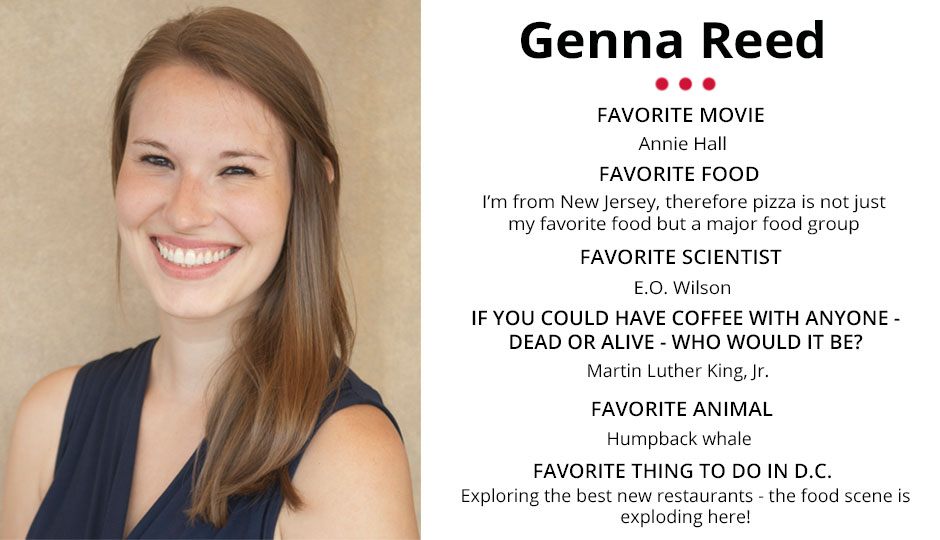
When Genna Reed discovered her love for biology after whale watching in Cape Cod as a kid, she pursued that passion in high school, college, and graduate school. It wasn’t until Genna took an environmental policy class that she realized she wanted to shift gears from science to policy and advocate for environmental change. Genna started working toward her Environmental Policy master’s degree the fall after graduating from college.

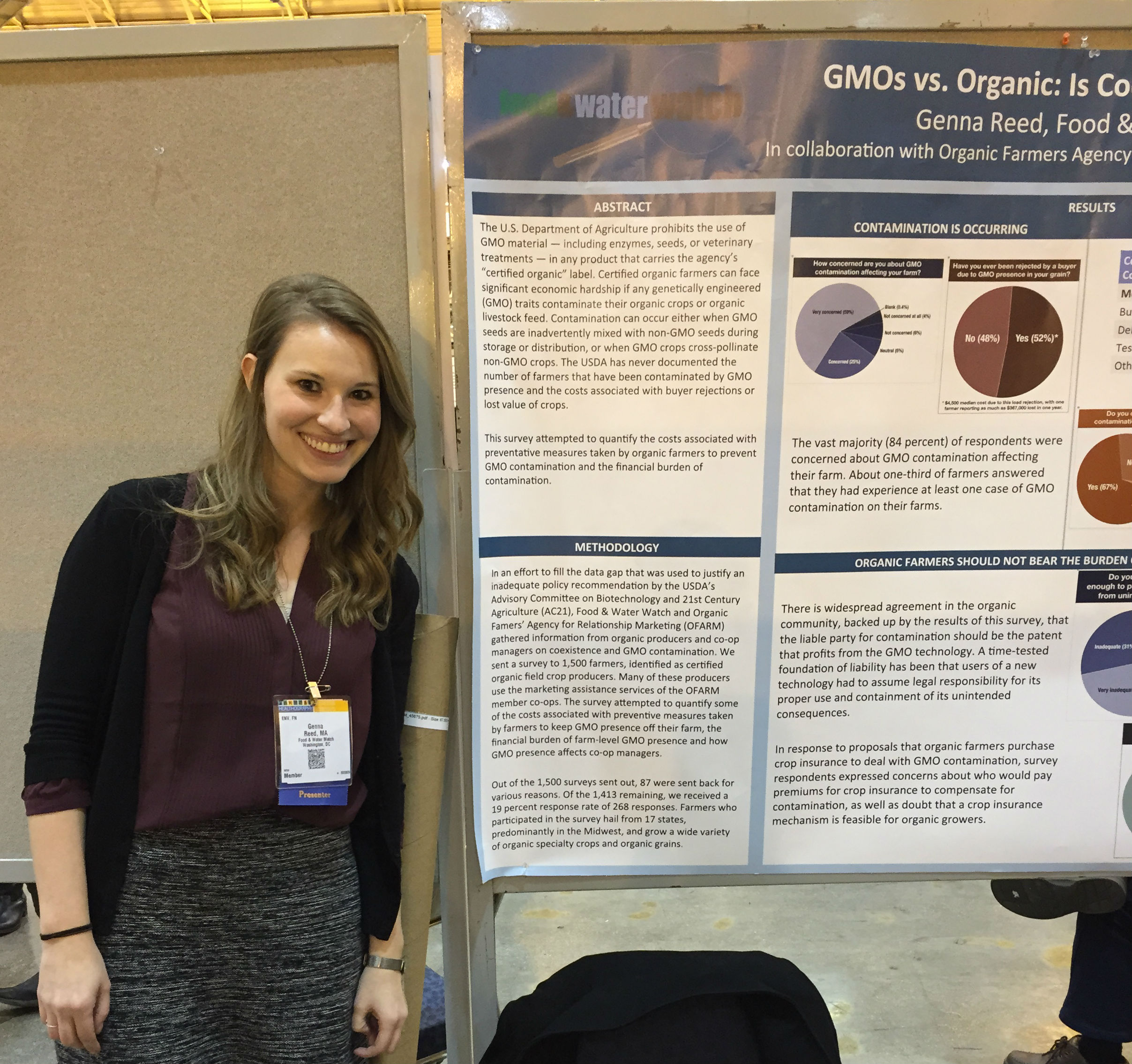
What we love about Genna’s story is that when she recognized what made her excited, she followed those instincts. When a class re-awakened her interest in environmental policy, she turned that passion into further learning and ultimately, a career. Genna now works as a researcher at Food & Water Watch, a Washington, D.C.-based non-governmental organization and consumer rights group that focuses on corporate and government accountability relating to food, water, and fishing. She spends her time researching and writing materials to support Food & Water Watch’s campaigns, specifically their GMO (genetically modified organism) labeling campaign.

Genna provides insight into how she spends her days, what it’s like being a researcher and advocate for the environment, and what the important things to know are when it comes to genetically engineered food. We’re inspired by how determined, passionate, and knowledgeable Genna is, and she really captures the ‘Seizing Your Youth’ spirit.

Name: Genna Reed
Education: B.A. in Biology and Psychology and M.A. in Environmental Policy Design from Lehigh University
Follow: @gennaclare / foodandwaterwatch.org

Carpe Juvenis: How do you define ‘Seizing Your Youth’?

Genna Reed: Youth is an advantageous time in a person’s life because individuals are most open to exciting opportunities and big changes, while also being resilient enough to manage these changes with ease. This flexibility begins to fade with age. It is absolutely essential that young folks take advantage of their freedom and explore new passions and interests whenever they can. Unless you happen to be Benjamin Button, you’re not getting any younger, so take advantage of it!

CJ: You majored in Biology and Psychology from Lehigh University. How did you decide what to major in?

GR: I have been very passionate about biology ever since going on my first whale watch in Cape Cod as a kid and becoming an instant die-hard humpback whale advocate. I was always more interested in my science and math courses during high school and carried that with me into college where my course load was predominantly biology and calculus courses. I was on the pre-med path until my senior year when I took an environmental policy course that re-awakened my interest in advocating for environmental change.

CJ: You also received your master’s degree in Environmental Policy Design from Lehigh University. What inspired you to go back to school to receive this degree?

GR: I realized at the end of my senior year of college that I wanted to shift gears from science to policy. I had worked at an environmental chemistry lab at the Meadowlands in New Jersey for two summers extracting very high levels of pesticides and other contaminants out of soil and water samples. I realized just how badly humans had polluted the environment and how essential it is that our society work to clean it up. Although I enjoyed working in a lab, I wanted to help work on concrete changes at the policy level. It just so happened that Lehigh had started up an Environmental Policy master’s program that seemed like a great fit for me. I began the master’s program the fall after graduating from undergrad at Lehigh.

CJ: You worked as an intern at the Wildlands Conservancy where you led environmental education programs and handled live animals including turtles, lizards, snakes, and owls. What were your biggest takeaways from this experience?

GR: I really loved working at the Wildlands Conservancy because I got to share my excitement about the natural world and environmental conservation with kids. I learned how incredibly important it is to expose children to environmental experiences at a young age and to teach them how they fit into the biological cycles and what they can do to help protect the environment. It’s really fun to channel kids’ energy and enthusiasm into becoming mini environmental stewards!

Genna 2

CJ: You were a National Network for Environmental Management Studies (NNEMS) Fellow at the U.S. Environmental Protection Agency. What was this experience like and what did you do as a Fellow?

GR: While I was completing my master’s thesis on wetland regulation and preservation, I was lucky enough to get a temporary fellowship position in Philadelphia with the EPA’s wetland division. I was able to apply things I was learning about wetland biological assessments into the policy world and to see firsthand how regulations are enacted. I spent my time with the EPA comparing and contrasting different ways to assess the health of streams and wetlands in order to find the best way to determine how these bodies of water can be protected from pollution and degradation.

CJ: You now work as a researcher for Food & Water Watch where your focus is on new technology issues within the food system. What does your role as researcher entail?

GR: I spend most of my time researching and writing materials (reports, issue briefs, fact sheets, op-eds, letters to the editor, blogs and testimony) that support our campaigns, specifically our GMO labeling campaign. I also work on federal comments on issues relevant to genetically engineered crops and animals and present our research at certain science and policy forums, stakeholder meetings and public hearings.

CJ: What are the three most important skills you need as a researcher?

GR:
1. Patience. It’s not always easy to find what you’re looking for.
2. Versatility. We have to be able to write about food policy to a range of different audiences.
3. Positive Attitude. Working at an organization that attempts to protect our food and water, we are up against very strong corporate interests, which makes it difficult to win our campaigns. We have to remain positive and keep on keeping on.

CJ: You research genetically engineered foods and the impacts that the technology has on farmers, consumers, and the environment. For people who are starting to learn more about genetically engineered foods, what are the most important things to know and keep in mind?

GR: The first thing I always tell people that are just learning about genetically modified foods, or GMOs, is that the way that this technology is currently used is first and foremost a moneymaking scheme for biotech companies that own seeds as well as the herbicides that are used with them. Herbicides are poisons, and their use has increased since GMOs were introduced. There are still many unanswered questions regarding the safety of GMOs and the herbicides that are used with them, and we have been the guinea pigs for this experiment since these crops and associated chemicals have been used for the past 20 years and foods made from these crops have been sold without labels the entire time. We should all be outraged at the lack of accountability and transparency from our regulatory agencies that have been keeping us in the dark about what’s in our food for far too long.

CJ: Food & Water Watch is an advocacy group with food, water, and environmental policy campaigns. Why do these issues matter to you and what can young people who are interested in these causes do to make a difference?

GR: There is not a single person in the world that is not affected by food, water and environmental issues. I have always believed that we have to take responsibility for the way in which we’ve treated our natural resources as commodities since humans began colonizing this planet. It’s high time that we begin thinking about the environment as having its own intrinsic value. Interested young people should get involved at the local level in their communities by getting educated on issues and joining with other concerned individuals to demand change.

Genna 3

CJ: Every day in your life must look different depending on your projects and the time of year, but what does a Monday look like for you?

GR: Monday mornings are spent drinking earl grey tea and going through my emails from the weekend and my to-do list that I’ve written on Friday afternoon. I start the day off finishing quick research tasks and then move on to longer-term projects as the day wears on. I try to do my writing either first thing in the morning or right after lunch, when my mind is the clearest.

Throughout the day, I usually have a couple of calls with our organizers on the ground to discuss campaign details and how we can work together to advance our cause or with representatives from other organizations who work with us in coalitions in order to build power to affect change. Hopefully by the end of the day, I have checked more things off the list than I have added.

CJ: What should a young adult who wants to be a researcher do now to set him or herself up for success?

GR: Having an inquisitive mind is a great way to begin preparing to be a researcher. Research is really just the process of finding an answer to a question or a set of questions. Another good skill to start honing is the ability to distinguish between good sources and questionable sources. It is essential that good research be backed up by solid fact and discerning between what is credible and what is not is imperative in this line of work.

CJ: What are some books, resources, and websites that have influenced you – either personally or professionally (or both)?

GR: E.O Wilson’s Biophilia was incredibly important in shaping and affirming my own opinions about the importance of protecting the environment and the role of humans in preservation. Aldo Leopold’s A Sand County Almanac was also very influential for me.

CJ: When you’re having a bad day, what do you do to reset?

GR: I usually go for runs to clear my head. After that, I spend time cuddling with my two cats, Jack and Willow, for comfort (if they’re in the mood, of course).

CJ: What are you working to improve upon – either personally or professionally – and how are you doing so?

GR: As a researcher with a dual monitor computer set-up, sometimes I find myself overwhelmed with inputs. Growing up in the age of multi-tasking and short attention spans, I sometimes struggle with devoting my full attention to individual projects as I’m working on them. I’m attempting to be more mindful of this and to fully immerse myself in one task at a time rather than spreading myself thin on a bunch of tasks.

CJ: What advice would you give your 20-year-old self?

GR: I probably would tell 20-year-old me to spend a little bit less time studying and more time exploring the state parks and natural beauty around Lehigh and farther out into Pennsylvania.

Genna Reed Qs

Images: Genna Reed

JC B
Professional SpotlightSpotlight

We’re always excited to meet fellow bookworms, so you can imagine how fun it was chatting with Jacqueline Clair, who runs the blog York Avenue, about all things blogging, photography, and of course, books! Not only is Jacqueline a blogger, but she’s also an operating room registered nurse. (Pretty awesome slash career, right?) Jackie decided to pursue nursing after earning her degree in Psychology, and she spends her days caring for patients, managing the equipment off the sterile field, and working under pressure.

When she’s not at the hospital, Jackie is exploring New York City with her camera in tow to snap photos of great places around Manhattan. Lucky for us, she also shares interior design tips and book recommendations. Keep reading to find out what it’s like to be an OR nurse, how Jackie balances her job with blogging, and how she makes time to read.

Name: Jacqueline Clair
Education: BA in Psychology, BS in Nursing
Follow: YorkAvenueBlog.com / Instagram / Twitter

CJ: How do you define ‘Seizing Your Youth’?

JC: I would define seizing your youth as seeking out opportunities and making the most of any opportunities that come your way. I would define it as also enjoying your youth, but at the same time making smart decisions to set yourself up for the future.

CJ: Where did you go to college and what did you major in? How did you decide what to study?

JC: I went for the first two years to SUNY Fredonia and then transferred to Stony Brook University for my last two years, where I finished up my Bachelors in Psychology. Then I went back for an accelerated nursing program and got a second Bachelors in nursing, which is how I became an RN. I decided to study Psychology because I just loved it. I thought all of my classes were so interesting and intriguing.

CJ: How did you decide to earn your nursing degree? How did you go about finding the right nursing school for you?

JC: I decided to earn a nursing degree because I wasn’t quite sure where to go with my Psychology degree. I wanted to do something active, where I wouldn’t be sitting behind a desk, and I was looking for a career where I could learn something new every day and always be doing something different. Nursing certainly fit the bill! I talked to a few nurses and it seemed like a good fit. I also liked that it incorporated Psychology in a way, since you’re dealing a lot with people.

CJ: You are an Operating Room Registered Nurse. What does your role entail, and what do your daily tasks look like?

JC: As an OR nurse, you’re either the Circulating Nurse during a surgical procedure, or the Scrub Nurse. When you’re scrubbed, you work directly with the surgical team, passing instruments, sponges, and sharps. You’re in charge of maintaining the sterile field, and together with the circulator you’re responsible for surgical counts. As a circulator, you interview the patient at the door, and help position them and maintain their safety during the procedure. You’re the one in the room who isn’t sterile, so you’re responsible for managing the equipment off the sterile field and getting anything that is needed during the procedure, like extra sponges and sutures, extra instruments, additional pieces of equipment, etc. You also do the charting, obtain medications needed during surgery, and discharge the patient from the OR to the recovery area.

CJ: What are the top three skills you need to excel as an Operating Room Registered Nurse?

JC: I would say you need to be adaptable, you need to be able to work well in a team setting, and you need to be able to work well under pressure.

JC A

CJ: What should a teenager or young adult who wants to be an Operating Room Registered Nurse do to set him or herself up for success?

JC: If you’re in nursing school and you think you may be interested in the OR, talk to your teachers and advisors and express that interest. See if they can set you up with any mentors, an OR rotation, or anything else. They may be able to set you up with someone you can talk to about it or interview, to get a sense of what it’s like. They may even be able to secure you a clinical rotation in an OR setting. You could also try volunteering in a hospital and expressing an interest in the OR or the procedure areas. You could also look into volunteering in some kind of outpatient or ambulatory clinic. Your OB rotation is likely to bring you into the labor and delivery area or into the OR for C-sections, so that’s where you really want to focus your efforts if you’re interested in the OR as a career choice.

CJ: You are also the blogger behind York Avenue. How do you balance blogging with your day job?

JC: I work on my blog after work and on the weekends. On weekends I’ll get started on a post or two and edit photos, or I’ll take photos of something I’m baking, something I want to feature on the blog, or places that I visit and am shooting for the blog. During the week, after work, I’ll edit pictures and write posts. Sometimes I use a vacation day to be able to visit a place that I want to photograph for the blog on a weekday, when it won’t be super crowded!

CJ: You have an entire category dedicated to books on your blog. We love that! What are some books that have changed your life?

JC: Well, I’m not sure that any books have changed my life, per say, but I certainly do have a few favorites! Recently I loved The Goldfinch, and some other favorites are The Little Stranger, I am Charlotte Simmons, and The Ruins. They weren’t life-changing, I just loved them.

CJ: What tips do you have for making time to read?

JC: The biggest thing that has freed up time to read for me personally has been giving up television for the most part. I’m not that into TV anyway so it wasn’t very hard, and I’m saving lots of money on cable. I’ll never give up Girls and Game of Thrones though!

CJ: How do you stay healthy and do you have a fitness routine?

JC: Unfortunately I don’t devote as much time to fitness as I should, but I do make it a habit to basically walk everywhere, even in the winter. I actually love walking around the city so it’s not very hard. I basically have been refusing to take cabs as of late, and it’s saving me tons of money and providing me with more opportunities for exercise. I do take the subway though!

CJ: How do you combat really hard days? What do you do to keep yourself positive?

JC: When I have really hard days I usually just think back to other hard days I’ve had, and remember how those were just moments that passed, and so I know the current bad moment will pass. I try to do things I enjoy if I’m feeling down, like go for walks, read, take photographs, or treat myself to a new book or a box of macarons or something. Talking to my Mom and Dad always helps too!

CJ: Is there a cause or issue that you care greatly about? Why?

JC: I get pretty passionate about the food industry. After reading The Omnivore’s Dilemma, Animal Vegetable Miracle, and some Michael Pollan articles I became pretty disgusted by all of the questionable and unnecessary additives and chemicals that are pumped into processed foods, even seemingly innocuous ones like bread and cereal. I’m not a particularly healthy eater (anyone who reads my blog knows about my massive sweet tooth), but I try to eat sweets that are handmade and small batch, many of which I’ve written about on my blog.

The places that I write about on my blog are usually the small producers that are making high-quality items by hand, with amazing ingredients, like Stick With Me Sweets and Orwasher’s. If I’m going to treat myself to something, I don’t want it to be full of artificial dyes and other weird things made in a lab. I strive to eat mostly organic when it comes to produce, dairy, and meat, and to eat as little packaged food as possible. It’s not easy because I absolutely have a weakness for cereal, but I just don’t trust the food industry at all. So I’m pretty passionate about the whole issue of GMO labeling, which I absolutely think should be required.

CJ: What are you working to improve upon – either personally or professionally – and how are you doing so?

JC: I’m constantly working on saving, de-cluttering, and paring down. Saving especially is something that I’m really working on. It’s so, so important to have a 6-8 month emergency fund and to start contributing to your 401k the MINUTE you start working. Youth is the biggest advantage you have on your side when it comes to growing a retirement fund - the more time your savings has to grow, the more money you’ll have down the line - and you will need it.

CJ: What advice would you give your 22-year-old self?

JC: Don’t rush things. I thought I needed to have everything figured out and nailed down right when I graduated college, but looking back, that wasn’t the case.

Jackie Clair Qs 1

JG 1
Professional SpotlightSpotlight

It’s not every day that we have the opportunity to interview someone who’s life ambitions are matched so closely to our own. Jessica N. Grounds, the co-founder of Running Start and also Director of Women for Ready for Hillary, is a champion for youth and specifically for women. While her professional career takes place in the field of politics, her mission and core purpose for the work she does is to empower young adults across the United States to engage with their communities, have their voices be heard, and make a real impact and change.

Jessica was gracious enough to answer some of our burning questions about what it’s like to be an advisor and leader in such a competitive world, and how she handles it all with grace and perseverance. We are thrilled to introduce to you Jessica N. Grounds.

Name: Jessica N. Grounds
Education: B.A. in Political Science from Pepperdine University; Graduate Certificate in Women, Policy & Political Leadership from American University; Executive Masters in Leadership from Georgetown University – The McDonough School of Business
Follow: Ready For Hillary | Running Start Online | WUFPAC | @Jessica_Grounds

Carpe Juvenis: How do you define “Seizing Your Youth?”

Jessica Grounds: Seizing your youth means taking risks and not letting what you think you “should do” get in your way. It’s so important to experience life and not hold back. I think it means to not let expectations get in the way of you stepping out and doing things. And especially for women, it’s very important for us to challenge ourselves and step out of their comfort zones.

CJ: What sparked your passion for politics and women’s issues?

JG: When I was in college, one of my classes required me to work on a political campaign. I decided to work for the re-election campaign of a local California Assemblywoman, Fran Pavley. Through that experience, I got to see what it was like to work on a campaign and how much responsibility you can have as a young person. But more importantly, I saw politics as a very public way to show people that women make decisive and strong public leaders. Later in my career I learned there are too few women in these important decision-making roles.

JG 4

CJ: You work with students who are not yet at the eligible age to vote. What makes young people so important and why has their empowerment become a primary focus in your career and life?

JG: My particular focus is to inspire young women to run for political office. What we find is that women don’t approach politics the same way men do. Girls don’t see politics as an avenue to pursue a career. We know that we need to talk to girls before they reach voting age to get them to consider political leadership. It is planting the seed early that is really instrumental in changing people’s perceptions, particularly for girls in leadership roles.

CJ: You’ve advised hundreds of female candidates throughout the country in their political ventures – what advice would you give to a young person hoping to set themselves up for success in the world of politics or non-profit?

JG: Build your network. Develop a robust network of people you know in different industries and communities. They will be vital to a potential political run because they will vote for you, volunteer, and donate. They’re also your ears and eyes to the people of the district. Build your people network and make sure it’s diverse in all facets of the word.

Think about where you want to be a political leader. Where do you want to build your network? Be strategic. Where you represent should fit who you are. For example, if you’re a conservative in San Francisco, you may not do so well.

Talk to people who have run for office before and get their advice about what they did to be successful. Also talk to those who have ran for your position to see what they did to win.

Lastly, don’t take no for an answer. Always ask, never assume.

JG 5

CJ: What has been one of the most unexpectedly interesting parts of your career to date?

JG: So, I’m now marrying a Republican who also works in politics. I’ve built this bipartisan network in both my professional and personal life, which has helped me with street cred and helps refine what I stand for as a Democrat. I feel like it also helped me hone how I talk about the issues I care about.

CJ: Every day in your life must be different depending on your projects and the time of year, but what does a Monday look like for you?

JG: I never plan anything after work on Monday’s. I am big on work-life balance. By creating these boundaries, it has helped me to better balance my work because I make sure to take care of myself. I always go to the gym on Monday nights. During the day, I don’t schedule a lot of meetings, if I can help it. Monday’s help me set the tone for the week and help me ease into things with control. I’m also on the phone a lot – building support for Hillary!

JG 3

CJ: You recently joined the ONE Campaign for a political delegation to Rwanda. What has that experience been like?

JG: That was a life-changing trip! Going to Rwanda was the most powerful experiences I’ve had to date. I was exposed to a lot of work that ONE champions to fund the combat against HIV/AIDS, malaria, and tuberculosis in sub-Saharan Africa. I also learned more about the economic empowerment space and how NGOs and government organizations are working together. I was particularly excited about the potential for women’s political and economic empowerment. I actually met with the Kate Spade team and they are producing product in Rwanda. Not only is it an effective business strategy to train women in the country, they are doing it in a way that was economically viable for the company. The line produced in Rwanda is called: “On Purpose.”

CJ: Leadership skills training for organizations and academic institutions is an area you thrive in – what are some ways young people can become better leaders?

JG: I always recommend learning how to talk about an issue you care about. Most people aren’t born with the ability to speak effectively, so learning how to be clear and concise in communication is really a powerful tool. Practice talking about what you care about, debates are effective. Also, work on your writing skills, that’s another tool you can use to talk about issues you care about. Push yourself to do public speaking exercises. Run for student government or sit on a board for an organization or volunteer for a local non-profit where you can be an advocate and speak about these issues.

Identifying mentors in your life will also help steer you in your career. Not everyone wants to lead and those that do sometimes feel lonely in their quest but finding mentors can encourage and nurture you to stay on the right track for inspiration. “Leadership is a lonely enterprise.”

JG 2

CJ: What is an area, either personal or professional, that you are working to improve in and how?

JG: I’m working on “being in the moment” more. I think as a professional type-A person, it’s very easy to think about what you did or didn’t do in the past, and what’s happening in the future. It’s difficult to be in the “here and now” and enjoy it for what it is. One thing that helps me do that is yoga (which I also need to work on doing more) because it helps you to think about your breadth and what you need to do in the moment. It’s a great thing to practice and cultivate.

CJ: Having a loaded schedule can sometimes be overwhelming. What do you do when you’re having a bad day and need to unwind or reset?

JG: If I feel like being healthy and unwind, I will go to the gym and work out hard and then hit the steam room because it makes me sweat. If I don’t feel like working out, I drink a very nice glass of Cabernet Sauvignon or Super Tuscan.

CJ: What is your favorite book?

JG: Old school favorite: Catcher in the Rye; New school favorite: Lean In.

CJ: What advice would you give your 20-year-old self?

JG: I would tell myself to chill out and that things work out the way they’re supposed to. Don’t be so worried about making the right steps all the time. I do feel lucky, though, because I found my passion very early in life and this helped me make decisions when there was a fork in the road. Over the years I have really learned to listen to myself.

Jessica Grounds Qs

Image: Jessica Grounds

Maurissacover
SpotlightYouth Spotlight

It’s perfectly fitting that Maurissa Walls, a senior at The George Washington University, is also the Director of Marketing and Public Relations for Smart Girls Group (SGG). She’s definitely one of the smartest people we’ve met and undoubtedly has an extremely bright future ahead of her. We found out about this inspiring woman by word of mouth - her name kept popping up in conversation around campus and it was no secret that she was a leader at GWU, making her mark one student at a time through freshman orientations and volunteerism.

As both a student and aspiring market strategist, Maurissa has never shied away from a challenge. For over two years she has strategized all of the marketing and advertising campaigns for SGG, manages a full team of Smart Girls, and even contributes to the digital magazine - The Smart Girl’s Guide. We are elated to introduce to you Maurissa Walls!

Name: Maurissa Walls
Age: 22
Education: George Washington University, Bachelor of Business Administration concentration in Marketing
Follow Personal: Twitter | Instagram | Facebook

Carpe Juvenis: How do you define ‘Seizing Your Youth’?

Maurissa Walls: Finding the balance between preparing yourself for adulthood and all of the responsibilities and pressures that come with it and being completely spontaneous enough to try as many things out of your comfort zone as you can. I think seizing your youth in this way allows you to make a life out of prioritizing having new, fun, adventurous experiences without compromising being a responsible adult because you’ve already made a habit out of finding the balance between the two.

CJ: What made you decide to attend college in Washington, DC, and how has the experience influenced you as an individual?

MW: I honestly ended up in DC because I was too scared at the time of moving to and living New York. I thought it would be a bit too overwhelming and hard for me to adjust. There’s nothing wrong with pacing yourself, if you know what would be best for you, and I truly believe DC is what was best for me at the time. I really wanted to be in an exciting city , and going to college in DC has impacted who I am today tremendously. Going to GW and living in DC has taught me not only to have an appreciation for culture and people but to also celebrate them. Being here has been an incredibly freeing experience. As I’ve developed and changed here I’ve allowed myself to celebrate my own complexities. I’ve learned from other people here that they can be a professional, and artists, and a mentor, and an activist, and so many things at once. I’ve learned not to limit other people or myself to just one box.

CJ: You are currently the Director of Marketing & Public Relations at Smart Girls Group. What does your role entail?

MW: My role at Smart Girls Group includes overseeing the strategic marketing and public relations vision of the company. I work with a really talented group of social media managers, PR managers, graphic designers, and writers to help drive our branding online and promote all of Smart Girls’ amazing offerings, services, and products.

CJ: What has been the most rewarding aspect of your work with SGG so far?

MW: Working with my team and our wonderful staff has been my favorite part of Smart Girls Group. I love seeing people grow in their positions. Going back to see work of girls on my team from a year or two years ago looks completely different from what they are able to do now. It’s so rewarding to watch people on my team develop their skills, talents, and professionalism and gain confidence in their own capabilities.

Maurissa 3 crop HZCJ: What has been the most unexpectedly exciting part of being involved with a young and growing company?

MW: I didn’t think it would be possible to grow such strong bonds with people online through emails and video conferencing. Those of us on staff are at several different colleges around the US and had never meet in the same room before. When we met for the first time all together at our first conference last summer, it was hard for us to convince people we were physically meeting for the first time. We get along and work so well together. We’ve created such strong bonds and I didn’t expect that to happen. Seeing this come to life at our conference for so many other girls that work together was so rewarding. It definitely proved to me that big results and big impact can come out of small packages.

CJ: How do you deal with difficult days and move forward?

MW: Remembering that I’ll still be alive in the end. There’s nothing more humbling and no easier way to calm yourself down than using a birds-eye view on a tough situation situation. My tough situations don’t even seem valid, considering what is going on in the world. Nowadays I’m usually laughing at my problems. There are some tough times that are harder to laugh through and I will just let myself feel what I am feeling for a moment. Crying, yelling, or whatever I need to do to get it out. But ultimately I realize I can either let myself just exist being upset or I can take action by doing the best that I can. The next day is probably coming, difficult or not, whether I like it or not, so I can at least try to make the best adjustments that I can to make it better.

CJ: What two main pieces of advice would you give to an incoming freshman college student?

MW: I told all of my new students the same advice all summer: use your resources and just take as much stuff as you can. You don’t realize how many “free” things that you are paying for in college until you start budgeting for life after. Then you realize how much free stuff and helpful resources that you left behind. There are so many departments at offices and schools that are begging for students to use their services and as a freshman I thought that I needed to work my way up in order to take advantage. Obviously that’s not true, you can jump in and start taking advantage. That’s not limit to school resources. I encourage freshman to apply for that internships they don’t think they can have or visit that place that they don’t think they can go to. The world is very forgiving of college students - especially freshman.

CJ: You are an aspiring marketing strategist. What originally drew you to this career choice and why?

MW: I’ve wanted to be in marketing since the 6th grade. I liked a writing project that we did where we had to design an ad and create the copy for a cereal commercial. I learned through that project that I like to influence people and I’ve kept with it because I realize there are multiple ways to do it. I’ll be going into buying in the retail industry, and that still feels like marketing to me, because I am in a position to influence and shape people’s experiences when they walk into a store. I like that marketing challenges you find new ways to influence because people are changing all the time.

CJ: What is the best piece of advice you’ve been given?

MW: My dad always told me growing up to stay connected with people. It’s becoming harder to do as you get older and busier, but I think it is extremely important. When people that I meet abroad, at school, or in programs have a real impact on me I try to stay connected to them. I think it helps to keep you aware of what you learned and how you’ve grown by be surrounded by the people that have helped to get you to that place.

CJ: What is your favorite book?

MW: Things Fall Apart by Chinua Achebe.

Maurissa Group HZCJ: How do you stay organized and juggle all of your responsibilities? Are there specific tools you use?

MW: I’m not a master yet, but I have system that seems to works for me. I use a combination of iCal, a plan book, and a clipboard of to-do lists. I’ve found that it helps me to have multiple touch points. If I have something on my iCal for the day with a notification before, see it in my planner, and have it on my to do list it usually will get done.

Color-coding is also really important and I make sure that I use the same color codes across my three planners. I like being able to look at my schedule at the beginning of the week and visually see that there are a lot of orange student org activities and know that it will be a fun week or to see a lot of blue academic slots to know that I have to crack down early in the week.

CJ: You will be graduating from the George Washington University in 2015. What are your next steps?

MW: I’ll be working in the Merchant (buying/planning) executive program at Macy’s HQ in New York. I am really excited about my job, I think it is well suited for my skills and it will challenge me in new ways. I think it will be a more creative and challenging way for me to use marketing to influence people.

CJ: What advice would you give to your 15-year-old self?

MW: I would tell myself that I am exactly who I am supposed to be. I’ve mostly had the same personality, spirit, and energy my entire life and I’ve always known that. I would tell myself to keep listening to myself. I’d promise myself that I would be really grateful for being exactly who I am later down the road and that it is for a good purpose.

Maurissa Walls Qs

Photos courtesy of Hannah Ziegler, Emily Raleigh, and Veronica Graves

Linda K 4
Professional SpotlightSpotlight

We have followed Linda Kim’s Instagram for quite some time now, and it’s always fun to see her gorgeous photos pop up in our feed. Linda is a food blogger at Delish Thoughts (so many great recipes!) and an E! News Segment Producer living in Los Angeles. She takes stunning photographs (read on for her tips for great photos) and has a keen eye for food styling. It’s clear how creative and talented Linda is through her photography, recipes, and career in entertainment.

Whether you’re into food, blogging, photography, media, entertainment, or pop culture, Linda Kim has all bases covered. Linda gave Carpe Juvenis an exclusive look into what ‘Seizing Your Youth’ means to her, how young people can get involved with a career in media, and how she manages her hectic days.

Name: Linda Kim
Education: B.A. in Drama and Sociology from University of California, Irvine
Follow: Delish Thoughts / Instagram / @lindak68

Carpe Juvenis: How do you define “Seizing Your Youth”?

Linda Kim: Seizing your youth means exploring opportunities and welcoming new adventures. It is important to live each day to the fullest and work hard to pursue your dreams.

CJ: You majored in Drama and Sociology at the University of California, Irvine. How did you determine what to study?

LK: To be honest, I wanted to study communications but it was not offered as a major. I thought drama and sociology would be a good combination to learn about society and be creative.

Linda K 1

CJ: You run the food blog Delish Thoughts. What sparked your passion for food and cooking?

LK: I loved watching my mom in the kitchen as a young girl. I was so fascinated how easily she prepared the most delicious dishes and I wanted to learn how to cook like her. I love hosting and cooking for other people. I think food brings people together and we can share great meals and fun conversations.

CJ: What is the best piece of advice you would give a baking/cooking enthusiast?

LK: I have learned a lot by watching cooking shows. It helps to see how things are done rather than just reading instructions.

Linda K 5

CJ: Great idea. You take gorgeous photos on Delish Thoughts and your Instagram. What are your top photography tips?

LK: It is all about natural lighting for me. Make sure you have great lighting and try taking photos at different angles to see what looks best.

CJ: What is your favorite meal or dessert you’ve ever made?

LK: My eggplant parmesan and blueberry crumble are favorites among my friends so I will make anything my friends enjoy.

Linda K 6

Linda K 10

CJ: You are also an E! News Segment Producer. What drew you to media and what does your job entail?

LK: I always had a love for entertainment and knew that is what I wanted to pursue. I love that there is a variety in media and you can work in different fields. As a segment producer, I cover TV and music stories, set up shoots and interviews with celebrities, and work on red carpets and events.

Linda K 2

CJ: What advice would you give to a young person hoping to set themselves up for success in the world of media?

LK: It is important to be a go-getter and be one step ahead. I always asked for more work and anticipated needs instead of sitting around and waiting for someone to give me work.

CJ: What has been one of the most unexpectedly interesting parts of your career to date?

LK: The most interesting part is the people I get to meet. I love meeting new people and have had the opportunity to meet friendly celebrities and become friends with my co-workers and colleagues.

Linda K 3

CJ: Every day in your life must be different depending on your projects and the time of year, but what does a Monday look like for you?

LK: It really depends on what is going on that day- if there is any breaking news, if I have to get in a lot of content that day, if I have a guest coming in studio, if I have to go off site for shoots. It could be a quiet Monday or a hectic Monday but I love that everyday can be different.

CJ: That’s awesome. When you do have those hectic days, what are your time management tips? How do you stay organized and efficient?

LK: I have learned to multitask pretty well so I can do a few different things at once to utilize my time. I make sure to write a list of things to do on my planner and keep track of projects in a calendar.

Linda K 8

CJ: What is an area, either personal or professional, that you are working to improve in and how?

LK: You may encounter unfriendly people in the industry but I tell myself not to take it personally and still keep a smile on my face.

CJ: Having a loaded schedule can sometimes be overwhelming. What do you do when you’re having a bad day and need to unwind or reset?

LK: Having a meal with friends always cheers me up or I like to have a quiet night, lay on the couch and watch my favorite shows.

CJ: If you could have lunch with anyone – dead or alive – who would it be and what would you eat?

LK: My grandfather. We would have the best chats when I was a little girl and I wish I could have that moment now with him. I would eat steak because that was his favorite.

Linda K 9

CJ: That sounds really nice. What advice would you give your 20-year-old self?

LK: To be bold and adventurous and not have any regrets. One of my biggest regrets was not taking the opportunity to study abroad in Italy.

Linda Kim Qs

Image: Linda Kim

Nick Rubin a
SpotlightYouth Spotlight

Nick Rubin is one seriously impressive 17-year-old. We met up with Nick for coffee in Seattle and discussed the many amazing projects he’s working on, including the app Greenhouse (which he built himself), a youth-run organization connector called YouthCorp, and his college applications.

As a high school student, Nick has loads of homework and the typical stress that comes with being near the end of your high school career. But Nick is approaching his time in high school differently by making the most of his time outside of class. He partakes in extracurriculars, spends time pursuing hobbies such as graphic design and photography, and makes time for himself by going on hikes and bike rides.

Nick undoubtedly seizes his youth. Read on to learn about how Nick learned to code, the inspiration behind his projects, and the top tips he would give someone who is just about to enter high school.

Name: Nicholas Rubin
Education: Lakeside School
Follow:
nicholasrub.in / @nickrubin / Greenhouse / Instagram

Carpe Juvenis: How do you define “Seizing Your Youth”?

Nicholas Rubin: I define “Seizing Your Youth” as taking advantage of the many opportunities that being young offers. For example, free time. We tend to have more free time than adults, which gives us time to focus on our passions and interests. Many people say that kids can’t make change, but I think that the opposite is true. I think it’s easier for kids to make a change – not only are we able to focus on what we’re interested in, but there’s something about youth that’s special.

CJ: You are the creator of Greenhouse, a free browser extension for Chrome Firefox, and Safari that exposes the role money plays in Congress. What inspired you to create Greenhouse?

NR: Ever since giving a presentation in a 7th grade social studies class, I’ve been really interested in the issue of money-in-politics. It’s not usually something kids care about, but even though I’m 17 and can’t vote for another year, I wanted to change that. I thought that the information about sources of funding of members of Congress wasn’t being made accessible to people, to the average citizen. It’s being buried away. The Federal Elections Commission (FEC) is the agency that’s in charge of making this information accessible to the public, but they aren’t doing a good job. It’s tucked away, and since most people don’t know where or how to find it, I wanted to put it where it’s more useful – on the web pages where people read about the actions of members of Congress every day.

CJ: How did you go about actually building Greenhouse?

NR: When I first came up with the idea, I didn’t really know how to code. I taught myself using a series of online resources, and this year I’m taking a formal computer science class in school. There are so many great instructional websites these days – Kahn Academy, Codecademy, and my favorite, Treehouse - which are all geared toward youth, so it’s easy to understand for a beginner.

I spent about 10 months and 400 hours working on Greenhouse. For the data itself, I’m collecting it from an organization called the Center for Responsive Politics, which takes the FEC data and makes it available to developers.

CJ: What cause or issue do you care greatly about and why?

NR: I’ve been working on one other important project since this summer. In August, I went to the Yale Young Global Scholars Program, and met 200 other kids from all over the world who all shared a passion for change and global affairs. Four of us recognized this, and we started something called YouthCorp. It’s an organization that connects youth-run nonprofits, projects, initiatives, and companies and combines their resources to fight a common issue.

We’re still figuring out the details, but in the first two months we’ve had around 20 youth-run organizations join us from all over the world. It’s great, and is something that I’ll definitely continue working on.

Nick Rubin d

CJ: You are also a photographer. What sparked your interest in photography and what camera do you use?

NR: I don’t really remember exactly when I started photography, but it’s been a long time. Back in middle school I went to a camp in the San Juans that had film photography as an activity. I learned how to use a manual camera, develop film, and more. Ever since then, I’ve loved it. I got my first point-and-shoot in 6th grade, eventually graduating to a film camera, and then a DSLR. Now I’m in my third year of photography at school, where I do both film and digital photography. My favorite type would probably be travel photography and portraits. They’re both fun to take.

CJ: You have done quite a bit of design work. Where do you draw inspiration and what tools do you use for your design work?

NR: I’ve been interested in design since a 7th grade art class, when we did some linoleum printing. I wasn’t much of an art student, but I really enjoyed carving out and printing shapes. I like simple, minimalist design, and use Photography and Illustrator to do most of my work.

CJ: You were a Top-10 finalist at MHacks IV for Quink, a free browser extension for Chrome and Safari that lets you read the news faster without leaving the page you’re on. What was that experience like and what advice do you have for pitching and making it all the way to the Top 10?

NR: It was an amazing experience. A 36-hour programming competition with almost no sleep may sound miserable, but it was actually tons of fun. Hard, but a great experience. The community tends to be more about learning, rather than competition, so it creates a great environment. Some hackathons have cash prizes, but many of these events are turning away from that and discouraging people from only going with the prizes in mind. Most people go for the experience, and that’s really what makes these events special.

My advice for kids interested in these events is that you don’t have to be an amazing coder, or even know how to code at all. Many attend as designers or simply attend workshops and learn as they go on.

CJ: How do you stay organized, and what are your time management tips?

NR: Truthfully, I’m not the best with organization and time management, but there’s an app called Things that has basically saved my life. It’s a to-do list, where you simply check things off when you’re done. I could probably work to be a bit more organized, and use things like calendars, but something simple like Things is enough for me. I don’t like being too structured.

CJ: Every day in your life must be different depending on school, work, and the time of year, but what does a Monday look like for you?

NR: On a typical Monday, I wake up at 7AM, drive my sisters to school, and go to my classes. After school, I continue to dedicate a quite a bit of time to Greenhouse, even though the attention surrounding it has died down a bit. I’ll spend an hour or two every day working on updates or responding to emails. Other than that, and my homework, I like to play tennis and go on hikes and bike rides.

CJ: What three tips would you give someone entering high school?

NR:
1. Try to make free time for yourself. School may be tough with homework, but it’s possible to have free time if you manage it properly. That’s what makes youth special, having time to do what you want. Making that time is important.

2. Don’t worry too much. That’s something I struggled with for the past few years. I’ve toned it down now, but don’t spend a lot of time stressing about school and your social life.

3. Do what you’re interested in, both in school and out. Pick classes and extracurriculars that interest you. For example, computer science is an elective course that I’m taking. Use your school’s resources to further your interests.

CJ: The college application process is ahead. What are you doing now to prepare for that?

NR: The process is just starting for me – I was actually assigned my college counselor yesterday. I’m probably planning on going on a school tour during spring break. I haven’t given the process much thought, but one thing that I’ve heard from people is to definitely start early. I may procrastinate with school assignments, but with something as big as college essays and applications, I’m going to be sure to start as early as possible.

CJ: What is one of your favorite books?

NR: Outliers by Malcolm Gladwell.

CJ: What is a book you read in school that positively shaped you?

NR: Catcher in the Rye by J.D. Salinger.

CJ: What is an area, either personal or professional, that you are working to improve in and how?

NR: Communication and reaching out to people. There are definitely a lot of people who could be useful to me and the projects that I’m working on, and reaching out to some of them would be really beneficial. When I need help, I tend to refrain from asking others, but I definitely want to change this.

CJ: Having a loaded schedule can sometimes be overwhelming. What do you do when you’re having a bad day and need to unwind or reset?

NR: Whenever I’m having a bad day, I try and find something to get my mind off of it. I like to play with my dog, or go on a hike or bike ride. Leaving things behind and not letting them get to me is important. Being in nature and spending time away from society really helps, and it puts me in a good state of mind.

CJ: What is the best piece of advice you’ve ever received?

NR: My parents and grandparents always told me before tests, “Good skills” instead of “Good luck.”

CJ: What advice would you give your 14-year-old self?

NR: Don’t worry as much! I worried about everything, and it would take up a lot of my time. I would spend more time worrying about an experience than actually enjoying it. This definitely could have changed earlier on.

Nick Rubin Qs

Image: Carpe Juvenis

Debbie Oberbillig
Professional SpotlightSpotlight

It was a pleasure meeting Debbie Oberbillig on a gusty and grey Seattle afternoon. As Founder and President of Allen Partners, a business coach, and board member, Debbie is extremely busy. She was kind enough to sit down with us for an exclusive interview about her career path, what she would advise her 20-year-old self, and the lessons she’s learned along the way. Debbie is intelligent, insightful, and an inspiring leader, and we were very impressed, to say the least.

As further proof of her success as an entrepreneur, Debbie was a 2015 Enterprising Women of the Year Awards winner. We are not at all surprised by this, as Debbie has grown her company, which provides finance and accounting talent optimization services for companies of all sizes and industries in the Pacific Northwest, from the ground up. We admire the fact that Debbie is a hard worker, but that she is also curious about the world and gives back to her community. No matter how busy her schedule is, Debbie will make time to help others. We’ve been inspired by her, and now it’s your turn.

Name: Debbie Oberbillig
Follow: @AllenPartners

Carpe Juvenis: How do you define ‘Seizing Your Youth’?

Debbie Oberbillig: “Seizing Your Youth” is appreciating who you are in this moment, being open to opportunities and exploring the world around you. I have observed that people are really getting serious early and kids aren’t allowed to be kids anymore. I think that your twenties should be spent figuring out who you are. Don’t be afraid to try new things - be bold and be brave. See the world, join the Peace Corps, or move to a new city. Discover who you are in order to determine what you want. That might be counter-intuitive to what you think you need to do – there’s a lot of pressure to start your career right away - but now is the time to learn who you truly are, which will help you pursue a career that you can truly be passionate about.

CJ: What school did you attend for undergrad and how did you determine what to study?

DO: I never graduated from university. I started working at 15-years-old and didn’t go to college until my thirties. My parents were children of the Depression so work was highly valued in my family. I also loved working and having money and the freedom that money gave me so I did not go to school right away. In my thirties I thought about getting a degree, so I started attending classes at a community college. I also took some classes at the University of Washington, but I got recruited by a great company and never finished. I originally was going to get a degree in business, but if I were to go back now I’d do something more fun like philosophy or psychology

CJ: You are the Founder and President of Allen Partners, a company you started in 2003 that provides finance and accounting talent optimization services for companies of all sizes and industries in the Pacific Northwest. What motivated you to start Allen Partners?

DO: My mom owned a successful agency similar to Allen Partners and I worked for her, which was where I learned the business. About the time my mom was getting ready to retire, I was recruited to work at Hall Kinion, another staffing firm, by a really smart woman who quickly became one of my professional mentors. With her guidance my specialty became organic growth, opening up new offices around the country. We grew the company from $3 million to $300 million while I was there. That experience and training is what led me to take the next step in my career, which for me was to start my own business.

CJ: What does your role as President entail?

DO: In the beginning I used to do everything. I’ve been a recruiter, a salesperson, the accountant - virtually everything. As we grew over the years I brought in two partners who also worked for the company and were passionate about its success. One of them is Director of Sales and Recruiting, running the sales division on a day-to-day basis, and one is the Director of Operations and Finance. As President, I focus on promoting the company by networking and continuing to grow our business with new clients.

CJ: Allen Partners focuses on employment intelligence and hiring smart. How do you go about recognizing and developing top talent? What are the most important skills to have in order to be considered “top talent”?

DO: Recognizing top talent is hard. It’s what all of our clients struggle with. It’s really a combination of practical and soft skills. A lot of people go to school and get their degrees and have practical work experience, but the determination of their success is equally based on soft skills. It’s just as important to be able to get along with people, communicate what you need, articulate what you’re looking for, and know what your values are. These are things that are not regularly taught or easy to teach and rarely thought about when attending college, but they are just as important.

Recognizing talent requires more than just looking at a resume, it takes a good conversation and asking the right questions to determine if candidates have the interpersonal skills, critical awareness and thinking abilities to not only do the job, but be an integral part of the team. It’s finding the right combination of hard and soft skills. It’s a secret sauce. Some people have it intrinsically and some people have to learn it.

CJ: What are the greatest lessons you have learned from running your own company?

DO: I’ve learned a lot of lessons. When you have a business, it’s imperative to remember that culture and profit are equally important. If there’s no profit, there’s no company. Profit is not a dirty word. You can have fun and have a great culture, but in the end, if the company’s not making money it doesn’t succeed. There were times when I didn’t think enough about the bottom line, and other times when I thought about the bottom line too much. A successful company learns to balance people and profit. You have to really care about both.

CJ: In your role as President, leadership is important. How have you learned to lead and what does it meant to be a leader?

DO: I’ve learned a lot over the years through trial and error that has made me a better leader. You have to care about your people and be empathetic. You have to also hold people accountable and recognize that people won’t always like you or the decisions you have to make as a leader. You want to take care of people, and you also have to do the right thing for the company.

CJ: As a recruiter and leadership advisor, you have observed many different types of leadership. What are some ways young people can become better leaders?

DO: You can be a natural leader but also have leadership challenges. One of the biggest things that I’ve observed is that young leaders struggle with holding people accountable because they want to be liked. New leaders many times avoid the tough issues, but to be a great leader you have to address issues right away. If something comes up and it’s a problem, it’s up to you to tackle it. Giving people feedback isn’t necessarily bad, although you have to learn how to do it effectively.

The other thing is that sometimes people feel like they have arrived when they’ve been promoted, and they stop doing the work needed to be a great leader. Great leaders lead by example, which is an old-fashioned saying, but it’s really true.

CJ: Bellevue LifeSpring is an incredible organization that fosters stability and self-sufficiency for Bellevue’s children and their families through programs that feed, clothe, and educate. What do your duties as a Board Member involve?

DO: When I first joined the board, Bellevue LifeSpring was building up their staff, so I was able to put my recruiting skills to work right away, as well as offering human resources assistance until we hired someone who could handle it. I really believe in the organization so I am always involved in our events, either by sponsoring, volunteering or both.

CJ: What does a day in your life look like?

DO: Lately I’ve been spending a good part of the day working on something I’m really passionate about - growing my professional coaching business. Coaching helps people see things in a new way by asking specific questions that transform how they observe the world. By simply looking through a different lens, you can change the choices you make and consequently, the results in your life. I love helping others to change their lens.

I’ve also recently become a Daring Way™ Facilitator candidate, which is a bit of a different coaching style based on the philosophy and findings of Brené Brown; a research professor, bestselling author and a top TED Talk contributor.

Of course, I’m still very involved in Allen Partners, although I’ve been able to step back a bit, as I’ve mentioned, to allow myself time to grow these other areas of my life.

CJ: How do you stay organized and efficient?

DO: I’m naturally very detail-oriented, which helps me stay organized. I use Outlook for scheduling, and I’ve just started color-coding to track how much time I spend on my projects. There is no secret to balancing, whether you’re going to school full-time or working full-time. It takes practice and dedication.

I’ve started a new thing: in the morning I write in my gratitude journal while I have my first cup of coffee. I just sit by myself and I think for about 30 minutes each day. I’ve noticed that we just don’t spend enough time reflecting. After that time, I prioritize my day by writing down the top five things I need to do. I do those five things first, and then after that anything goes. When you limit it to the top five, you’re usually able to get it all done.

CJ: What is the best moment of your career so far?

DO: Right now! I’ve had a great career and I’ve been really lucky. I love everything that I do and it keeps getting better. My first jobs were office jobs where I worked 8am-5pm, and I just think right now is really fun because I have so much flexibility.

CJ: What advice would you give your 20-year-old self?

DO: In my twenties, I didn’t have much of a life besides working and socializing. I would tell myself to travel more – try new things, meet new people. I got very serious about work too soon, which is why I now really encourage young people to “seize their youth!”

Debbie O Qs

Professional SpotlightSpotlight

We met up with Ian Manheimer on one of the coldest days New York has seen in a long time. A leader in youth empowerment and an entrepreneur, we were extremely excited to get the opportunity to meet Ian in person. Ian is currently the Vice President of Product Management at Charitybuzz where he improves user experience and exercises his leadership skills by managing a team.

Ian is also the founder and president of RFK Young Leaders, a program of the Robert F. Kennedy Center for Justice & Human Rights. When he’s not busy creating new relationships at Charitybuzz, helping young human rights defenders take action for social justice and human rights, or generously helping those he’s met reach higher goals, he can be found working on some seriously cool projects like a book about pizza in NYC. Carpe Juvenis is excited to share the Spotlight of the inspirational and talented Ian Manheimer!

Name: Ian Manheimer
Education: BA in Communications and English from Tulane University
Follow: rfkcenter.org / @ianmanheimer

Carpe Juvenis: How do you define “Seizing Your Youth”?

Ian Manheimer: There’s a famous speech Robert F. Kennedy gave called “Day of Affirmation” that was given to a student group in South Africa during apartheid. It goes:

“This world demands the qualities of youth; not a time of life but a state of mind, a temper of the will, a quality of the imagination, a predominance of courage over timidity, of the appetite for adventure over the life of ease.”

He’s talking about a quality of youth where you’re willing to take risks and live in a much more open world of possibilities. Something happens when you get older where those possibilities become less, so he’s talking about trying to spread that spirit around the world to all people. Robert F. Kennedy is a huge part of the work I do and his shadow looms large over it.

CJ: You studied Communications and English for your undergraduate degree at Tulane University. How did you determine what to study?

IM: I love to read. I was always educating myself and reading books, even if they weren’t in the syllabus. They were the books I wanted to read. My major came from a passion of reading, writing, spreading around ideas, and having the boldness to think that I had an idea or two worth sharing at the time.

Communications and English are about expression. I love journalism, and the intersection of media and democracy. A functioning press in critical to democracy. In 2005, I graduated and a couple big, old newspapers were starting to shudder. I was writing in New Orleans for a couple of papers, but I didn’t think it was the right time to stake a career in that industry so I sat on the sidelines for a bit. I fuse those journalistic practices that I learned into my career.

CJ: You co-founded Glassbooth.org, a nonprofit site to help people decide who to vote for in public elections, when you were 24-years-old. The success of Glassbooth.org inspired you to pursue another online model, Measy.com, that could help people make decisions. How did you know when the right time to take the risk of starting your own company was?

IM: That was a really intuitive jump where I wasn’t the most informed or most capable, but there was an earnest feeling that if I made something I wanted to make and use, there would be others who also wanted to use it. I thought it could be a real thing of value, and then I went for it really hard. I had nothing to lose, and I still try and live as if I have nothing to lose. “Why not?” is always a great question, and a great way to overcome fears. I just grabbed some of the talented people around me and asked, Why not? For me, going from nothing to something for the first time just let me know that I was capable. You just have to jump in.

CJ: You are the founder and president of RFK Young Leaders (RFKYL), which is dedicated to empowering young human rights defenders and motivating a diverse community of young people to take action for social justice and human rights. What has it meant to you to be someone who is inspiring youth and helping people put into action what they want to do?

IM: It’s been humbling and amazing to be able to carry the torch for the work Robert Kennedy started. When he was killed, rather than build a huge monument to his person, his work lives on through his foundation and it allows his vision and dream to extend past his early expiration. Being able to carry that mission out to new generations has been amazing. It means a lot to me.

For me, what means the most is to bring young people into their first experience with social justice and civics, and for them to have a positive experience, and realize their power. This experience leads to a lifelong practice of civics and social justice. When I see those things happening, and those light bulbs going off, that’s what gets me excited.

We’re an all-volunteer program so I also have a day job. My role at RFKYL includes extending campaigns, like our main campaign, which is organizing New York farmworkers. Working with farmworkers, meeting with farmworkers, meeting with advocates of farmworkers. We’re growing the organization and opening new chapters across the country. We meet with young leaders across the country and connect young people with human rights defenders out there to spread inspiration and get young people excited about social justice issues. We’re trying to capture an entrepreneurial spirit of our generation within the confines of foundation’s work.

CJ: You are the VP of Product Management at Charitybuzz. What does your role entail?

IM: I’m responsible for internal products and the products you see on desktop and mobile. I extend business goals via our digital assets and try to create a better experience for our users. We work on making their lives easier and help them find the awesome things we have to offer. I lead a team of developers and designers. It’s a lot of interdisciplinary work bringing a whole company together around our main business goals as they manifest in digital.

CJ: In many of your roles it sounds like you take on a leadership position. What are two of the biggest lessons about being an effective leader?

IM: One thing I’ve learned about being a leader is that you have to let people create their own boundaries and then let them excel or fail within those. I never give someone a deadline, ever. I always ask when they think they’ll be able to get a task done and then hold them to their own expressions of what they’re capable of. It’s always better to give people the autonomy to succeed.

For me a leader is really an administrator and has a certain role, but he or she doesn’t have more votes than anyone else. It’s my role to inspire and to help people become their best selves. I love to invest in people and help them grow. It’s always a team. You’re a leader, but it’s no different a position than a designer or developer.

CJ: How did you go about learning the logistics of starting your companies (logo design, website/e-commerce platform, marketing, finance/budgeting, etc.)?

IM: I’ve never done anything that’s just me. I don’t think you can ever be successful when it’s not in a team. Everything you do will be the success of the team. For me it’s always been sourcing and aggregating talented people. I’m a bit of a generalist and I don’t have too many technical skills, but I can get a team together, chef it and whip it up, and it comes out great.

I have deep respect for technically talented people and always want to respect their craft and learn as much as I can. While I’m not a developer, I’m constantly learning everything my layman’s mind can take on. With anyone I work with, I try to understand what they do, out of respect.

CJ: What has been one of the most unexpectedly interesting parts of your career to date?

IM: I worked for this very ambitious organization called Dropping Knowledge and it was a combination of a team at MIT and artists in Berlin and they were trying to create this global knowledge platform. It was weird and wild and wonderful. I spent a month in Berlin with people who had open lifestyles, and it completely opened my horizons. For me that was an opportunity to do this wild thing, and that alone was enough for me to want to take that on.

CJ: What are your time management tips? How do you stay organized and efficient?

IM: I love products and tools to help you make your life more efficient. I surround myself with an ecosystem of products that will do the work for me. There’s a hubris people have about their own sense of time and concentration that leads to failure. For example, if you have a thought and you tell yourself you’ll remember it later, how many times do you go to conjure that thought and it’s gone? Having those things around you to manage your life is helpful.

For my daily management I use a tool called OmniFocus, which takes the Getting Things Done methodology and puts it into software form. It’s about getting the thoughts out of your head immediately and then sorting them later. There is one tool that I love called Boomerang, and what it does is ping me if I haven’t heard from you after sending an email. I then don’t have to remember our conversation and stress about it because the email will come back to me so I can keep the conversation moving.

CJ: What is an area, either personal or professional, that you are working to improve in and how?

IM: If I’m looking to make a hire at my organization, their interest in becoming better at the thing they do, is the number one quality I look for. I believe that you don’t have a mind that’s in a fixed state. I’m interested in growing my mind and being with other people who have that same appetite for self-improvement.

I’m interested in self-improvement in the form of expanding my mind through meditation or just trying to grapple with new concepts that are foreign and difficult. If I read an article about mathematics I won’t grasp too much of it, but it will challenge me in a way that will create new neural pathways. I’m constantly trying to immerse myself in some challenging things. Right now I’m learning how to code, which is challenging, but the challenge alone is the value.

CJ: Having a loaded schedule can sometimes be overwhelming. What do you do when you’re having a bad day and need to unwind or reset?

IM: My approach to mood is psychosomatic – there’s a mind body bridge. I try to be aware of that. I love to play basketball, do yoga, and these types of things to treat my body well and get as many chemicals firing in my brain. At the end of the day, gratitude is the most grounding concept that you go back to. If you’re having a bad day, think of someone having a worse day. It always works.

CJ: What book influenced you when you were younger?

IM: Fast Food Nation by Eric Schlosser.

CJ: What advice would you give your 20-year-old self?

IM: Nothing I’ve done has ever been just me. At a young age, I would be mindful about people around you who are great at the thing that they do. Be good to those people and do things for them and stay in touch with those people. Grow your network. After years of that practice, you can activate on anything.

I would also put a couple of dollars away. A couple of dollars when you’re 20 is a lot of dollars when you’re older. Think about your future self. I have a character who is Future Ian and I’m also thinking about this guy.

Ian Manheimer Qs

Image: Ian Manheimer; unsplash

grace main 2
Professional SpotlightSpotlight

We met Grace Gordy at a Seventeen Magazine internship in college. We worked together in the fashion closet, and it was clear that this girl had an eye for style. Flash forward years later, and Grace is running her own clothing store, Honey and Hazel Boutique, in Georgia. A surprise? Hardly. Grace has serious determination and a passion for creative endeavors. It’s not every day you hear about a young twenty-something opening up shop with trendy (and affordable!) contemporary clothing.
Grace opened Honey and Hazel Boutique with her mother, and this power duo is impressing us with their positivity and desire to learn more through their experiences. From an early age Grace knew that she wanted to be involved with fashion, and daily she makes her dreams come true. After spending time interning in the fashion industry and working for other clothing stores, Grace learned many skills along her journey and implements them on a daily basis. We’re excited to introduce you to our friend, style inspiration, and total #girlboss, Grace Gordy.

Name: Grace Gordy
Education: BFA in Fashion Marketing and Management from Savannah College of Art & Design
Follow: Facebook / Instagram

Carpe Juvenis: How do you define ‘Seizing Your Youth’?

Grace Gordy: To me, seizing your youth is all about creating your own path in life (or “march to the beat of your own drum”) and not worrying about what others are doing. I used to get so caught up in what I thought I should be doing at a particular age and always felt behind in my “career path,” but now I realize how thankful I am for all of my experiences because it led me to my ultimate dream come true.

Also I think seizing your youth means taking advantage of all of the opportunities that come your way. Your youth really is the best time to explore, be creative, meet people, make memories and experience as much as you can. Just live life with no regrets.

Grace 3

CJ: You majored in Fashion Marketing and Management from Savannah College of Art and Design. How did you determine what to study?

GG: From a very young age I knew I wanted to be involved in fashion. I used to study fashion magazines from front to back and was determined to work for one so choosing a major was never any question; it was going to be fashion! I grew up in a small town where no one understood how you could make a career in the fashion industry and was actually told by teachers to go into a more “realistic” field, but I never let them sway me. My parents have always been so supportive of my choices and me and have always told me to follow my passion no matter what. I couldn’t be more thankful for them! For anyone interested in majoring in fashion I would certainly recommend that you look into SCAD (Savannah College of Art & Design). It was the most challenging four years of my life, but it paid off in a huge way. They have wonderful professors and a very well-rounded curriculum!

CJ: That’s incredible. You definitely put that education and the skills you learned to good use. Together you and your mother opened Honey & Hazel Boutique, a trendy contemporary clothing shop. We love that! What does your role entail and how do you and your mother divide up responsibilities?

GG: We are both co-owners so our roles basically entail everything! We both have total input into everything we do and are both always in the shop whether that means being on the floor helping our customers or in the office doing paperwork. She’s better at keeping up with the books and I handle most of the social media and marketing. We are very fortunate to have the kind of relationship we do; we are best friends, business partners, and mother/daughter. Opening this boutique together is such a great way for us to spend quality time together and do what we do best, which is being creative!

Grace 5

Grace 4

CJ: You’ve done many interesting things throughout your career such as interning at Seventeen Magazine, working as a stylist, working in marketing, and being a logistics and operations coordinator. What have you learned from these experiences and how have they influenced you with opening your own shop?

GG: Having numerous jobs and internships since college really helped me to determine exactly what I wanted to do. It has always been a dream of mine to open a boutique. However, I thought it would happen MUCH further down the road. There have always been so many facets in the fashion industry that I was interested in and thankfully I was able to work and dabble in different areas to know what I did and didn’t like. Earlier I said that working for a fashion magazine was my goal and I was so blessed to get an internship in New York City at Seventeen Magazine. It was the most amazing experience of my life thus far, but it definitely taught me that that is NOT the place for me.

As much as I loved New York and loved the idea of having a fashion job in “the big city,” I knew I wasn’t cut out for it. I like the south too much, what can I say? After graduating I ended up moving to Charleston, South Carolina where I absolutely fell in love with the town and its charm. I had a few different jobs there, but my favorite and the one that ultimately led me to where I am now was being an Assistant Manager at a little boutique there. I loved the team of girls I had the pleasure to work with and loved the smaller feel of a boutique atmosphere. I’m definitely a people person and it gave me the opportunity to get to know our customers, as well as do the fun stuff, such as merchandising and being creative. That job definitely made me realize I was ready to have my own store!

CJ: That’s really inspiring. As great it is to figure out what you do love to do, realizing what you don’t want to do is just as important. What are the greatest lessons you have learned from running your boutique?

GG: Always work hard, be kind, and have patience! Also I’ve learned when you’re feeling overwhelmed, just stop and take a breath. Everything will be okay! Running your own business is a TON of work, but it’s extremely rewarding!

Honey 3

CJ: What do you wish you had known before opening Honey & Hazel Boutique?

GG: Oh gosh, I wish I knew more about the accounting side and obviously that’s a HUGE part of having a business. Numbers and analytics have never been my thing. I’m a visual, creative person, but I’m certainly learning more every day.

CJ: What can a young person who is interested in owning a boutique do now to set themselves up for success?

GG: Get as much experience as possible! I interned at many different places to figure out what was best for me and what I wanted to do.

CJ: What would you say to people who are uncertain about starting a business? What motivated you to take the leap?

GG: Starting a business is scary and I honestly have learned so much over the last year that I never knew about before. My mom and I took the leap based heavily on faith. We were and are extremely passionate about what we wanted to do and believed in our idea. We just figured there’s no time like the present so let’s just work our hardest and see what happens! So far it’s going extremely well and I couldn’t be happier!

Honey 4

honey 9

CJ: Every day in your life must be different depending on what’s happening in the shop and the time of year, but what does a Monday look like for you?

GG: Typically Monday isn’t a super busy shopping day so it’s a good time to re-merchandise the store, order inventory, clean, and meet with my Mom about what’s going on that week or what we need to get accomplished. We normally have a gazillion emails to respond to and plenty of bills to pay! I’m always Instagramming our new merchandise and coming up with new ways to showcase our products. Trust me, there’s ALWAYS something to do!

CJ: What are your time management tips? How do you stay organized and efficient?

GG: I’m a big proponent of making lists, writing things down, and having a planner with me everywhere I go. I have the worst memory in the world so if I don’t set reminders on my phone and or write it down I will be sure to forget! Plus, it’s a good excuse to get cute organization supplies!

Honey 6

Honey 1

CJ: We agree! What is an area, either personal or professional, that you are working to improve in and how?

GG: I definitely struggle with trying to do everything myself and it can be really stressful and overwhelming. I am trying to work on how to better delegate tasks and jobs to different people. Especially as our business grows and we build a bigger team through employees, I need to learn how to not try to take on everything and let others help me. That is something I’ve always struggled with. It’s even harder now because my boutique is like my baby!

CJ: What advice would you give your 15-year-old self?

GG: I would tell my 15-year-old self to not stress and worry so much. Everything works out the way it’s supposed to and you just have to have faith and follow your dreams!

Grace Gordy Qs

Honey 2

Image: Grace Gordy

Katie b
Professional SpotlightSpotlight

We fell in love with Katie Evans’ designs when we first laid eyes on them. It’s not hard to adore her bright and colorful designs. Having freelanced, worked at kate spade, West Elm, and Gap, Katie is no stranger to hard work and late nights. Now working as the Art Director at Ivanka Trump, Katie is involved with social media, editorial stories, and marketing. We were very excited to meet with Katie at the Ivanka Trump office in New York City, which is powdery pink and filled with inspirational images and quotes. We are motivated by Katie’s creativity and hard work, and we know you’ll be just as inspired.

Name: Katie Evans
Education: B.F.A. in Graphic Design from the Maryland Institute College of Art
Follow: @heykatieevans / katie-evans.com / ivankatrump.com

Carpe Juvenis: How do you define ‘Seizing Your Youth’?

Katie Evans: Taking chances and not being afraid to make mistakes. You’re young and now is the time to experiment with what makes you happy and what doesn’t.

CJ: You received your BFA in Graphic Design from the Maryland Institute College of Art. What sparked your love of design?

KE: I attended an arts magnet middle school and high school where I was a visual arts major concentrating in drawing, painting, and sculpture. In high school I continued those studies and did a crossover into the Communications department to take a graphic design class. CD album covers and booklets were what originally sparked my interest in design. I remember pinning them on my bedroom walls. I also designed a couple of covers for my friends’ bands.

When I was a junior in college, I still didn’t know exactly where I wanted to take my career. A professor gave me an assignment to spend a weekend collecting anything that I was attracted to. The next week I brought back a bunch of Martha Stewart’s Blueprint Magazines, editorial shoots from Lucky Magazine, and a bunch of fashion ad campaigns. My professor was like, “Duh, you should be in fashion.” I questioned her about how I could play a role in fashion as a graphic designer. She told me that fashion companies need graphic designers – they do the windows, the packaging, and the hangtags, etc.

Katie c

CJ: You are the Art Director at Ivanka Trump. What does your role entail?

KE: Ivanka started her licensee businesses a while ago, and she recently hired a small team to revamp and bring new life to the brand. We recently launched our new site, ivankatrump.com, that includes articles on work, style, travel, home and play.

I concept all of our editorial content on the site and our social media channels. Everyone does a bit of everything here because we are so small, which is great because you can be involved with different aspects of the brand. Our team makes all of our ideas come to life. I still do graphic design which I think a lot of Art Directors don’t do anymore. It keeps me on my toes.

CJ: You freelanced as an Art Director, Graphic Designer, Illustrator, and Consultant for years while also maintaining jobs. How did you go about securing freelance work, and what advice do you have for those interested in freelancing?

KE: I originally started freelancing because I needed the extra money. I always had a steady job and paycheck to fall back on, and freelancing let me experiment and find out what worked and what didn’t. For my first freelance job, I was paid $500 to design 10 different stationery cards for a new company. Looking back on that now is crazy to me. I want to smack my 22-year-old self and ask what I was thinking! I spent so much time on those cards. It should’ve been $500/per design. When I figured out what I wanted my freelance projects to be, I was able to pick the ones I liked the most. Most of my jobs came from word of mouth with a mix of referrals from social media and LinkedIn. I did freelance as a career for a little bit, and then Ivanka Trump lured me back into the corporate world.

If you’re thinking about going strictly freelance, you have to be passionate about what you’re doing. You have to be a go getter or you will go nowhere. You also have to be organized because now you are a bookkeeper, assistant, answering emails all day, and you still have to pump out the creative. It took time, but I was able to figure out how long projects would take me and account for client feedback to get it all done in time to start my next project. It was tricky to find that right calculation, so being flexible was important.

When I first went full-time freelance, I had nine clients. It was a disaster on my side, but I put on a good face for my clients. I had no social life, I was overworked, and I will never make that mistake again. I think the happy medium was 3-4 clients, with 2 recurring clients and 2 rotating projects. I had to be very strict with my clients about deadlines so that it didn’t interfere with other jobs.

women who work

CJ: How did you stay organized and efficient while balancing freelancing with your corporate jobs as a Graphic Designer?

KE: Google. Google has helped me do everything. I used spreadsheets for my bookkeeping and the calendar for meetings and deadlines. I would have each client assigned a different color so I could visually see the different projects I had. It worked because I could access those files from wherever I was – whether it was on my computer or phone.

CJ: You’ve worked as a graphic and web designer at some amazing places such as kate spade, West Elm, and Gap. What are your biggest takeaways from these experiences?

KE: The biggest thing I learned was that if I’m not passionate about the brand and what I’m marketing, I can’t do my job 100%. At kate spade, I lived and breathed that brand. The projects were so much fun. The kate spade team was very small so I was able to get my hands on everything, from window installations to stationery collections to working on photo shoots. I loved that so, so much. Every day was different and I was building a great portfolio.

The other companies I’ve worked for were much larger and at those jobs I was hired to do one thing and that thing only. They had huge teams to do everything and I realized through those experiences that I thrive better in smaller environments where I can play a part in all aspects of a project. I like to see things from start to finish.

CJ: What is the best part about being a designer? The most challenging part?

KE: The best part is telling stories. Just being able to tell a story about what a girl is doing and what she’s wearing and what she’s thinking and feeling. Finding a way to bring that story to life is the best part.

The most challenging part is finding the balance between making something beautiful but also selling that product. It’s tough to be conscious of both.

Katie a


CJ: Every day in your life must be different depending on your projects and the time of year, but what does a Monday look like for you?

KE: 7am: Rise and shine! Go for a run! #TeamIvanka is training for a half-marathon in April. Most of us are new runners and can’t imagine running 13 miles. So far 4.5 has been my most.

9am: Take the F train uptown. Read theSkimm on my ride up.

10am: Write out my to-do’s for the day. Respond to emails.

10:30am – 2pm: Plan our next editorial shoot, pull inspiration, select models, snap a photo of Ivanka for Instagram, and edit videos.

2:00pm: Lunch! If I eat too early the day goes by much slower.

2:30 – 5:30pm: Work with our Editorial Director to plan the next month of stories. Call people and brands that we want to collaborate with, design creative for our social media channels, a little bit of pinning to Pinterest.

5:30 – 6:00pm: Regroup with my creative team to make sure we’re meeting deadlines.

6:00pm: Out the door!

Trump Tower

CJ: What should a teenager or young adult who wants to be an Art Director or Graphic Designer do now to set themselves up for success?

KE: Be multifaceted in your line of work. If you’re a graphic designer, take a variety of art classes and learn as much as you can. You’ll be more valuable to your employer. As a designer, explore print, packaging, publication, digital, and visual. It will set you up later in your career to think about a project holistically.

Also, be nice. It still blows my mind how small this world is.

CJ: What is your favorite book?

KE: I just finished reading You Before Me by JoJo Moyes. I laughed and cried.

CJ: Having a loaded schedule can sometimes be overwhelming. What do you do when you’re having a bad day and need to unwind or reset?

KE: I like to take deep breaths, go to the gym, and shop.

CJ: What advice would you give your 15-year-old self?

KE: Your career path is going to be hard work, but it’s going to be worth it. And pay attention in your foundation art classes! Find a way to enjoy it and embrace your art style. You may think they’re boring, but they’re teaching you the basics of art that will come up in every aspect of your job.

Katie Evans Qs

Image: Carpe Juvenis